
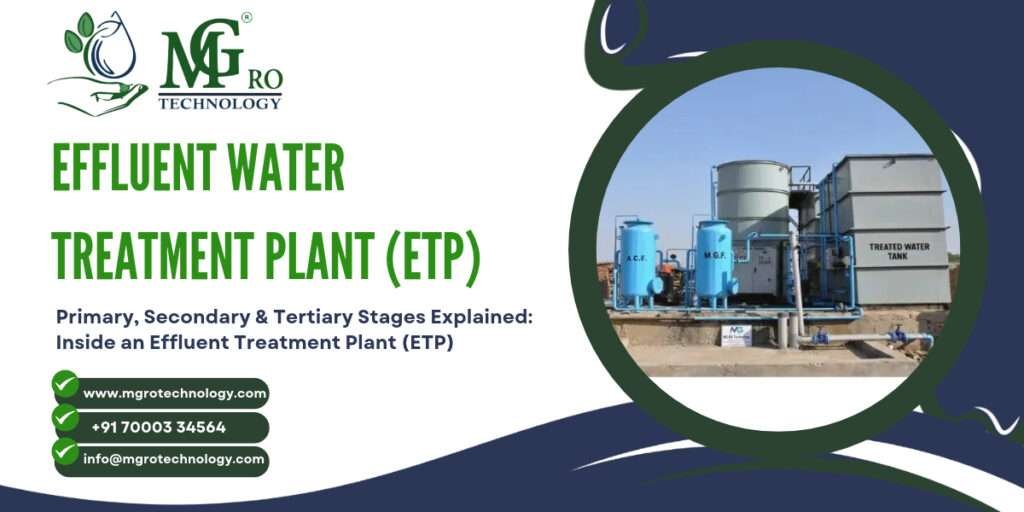
Manufacturing industries across chemical, textile, pharmaceutical, food processing, engineering, and packaging sectors generate process wastewater containing suspended solids, organic matter, oils, heavy metals, and varying pH levels. Discharging untreated industrial effluent harms surrounding ecosystems and violates environmental compliance norms. An Effluent Treatment Plant (ETP Plant) purifies this industrial wastewater through a structured sequence of physical, chemical, and biological treatment stages.
This technical guide explains the core theoretical principles behind preliminary, primary, secondary, and tertiary treatment inside a modern industrial ETP system.
Why Industrial Wastewater Requires Multi-Stage Treatment
Unlike domestic wastewater treated in a Sewage Treatment Plant, industrial effluent varies widely in chemical composition, toxicity, temperature, and pollutant concentration depending on the manufacturing process:
Organic & Chemical Load: Measured through Biochemical Oxygen Demand (BOD) and Chemical Oxygen Demand (COD), representing biodegradable and non-biodegradable organic compounds.
Suspended & Colloidal Solids: Fine insoluble particles, fibers, pigments, and precipitates that cause turbidity and siltation.
pH Extremes & Free Oils: Acidic or alkaline process streams along with emulsified or floating oils and grease that inhibit downstream biological treatment.
Because no single unit operation can remove all pollutant classes simultaneously, an ETP Plant separates contaminants progressively across dedicated treatment zones.
Preliminary & Primary Treatment: Physical and Chemical Separation
The initial stages of an Effluent Treatment Plant stabilize incoming flow and remove coarse debris, oils, and settleable solids before biological oxidation begins:
Bar Screening & Grit Removal: Coarse and fine screens intercept plastics, rags, fibers, and heavy grit particles to protect downstream transfer pumps and piping from mechanical blockage.
Oil & Grease Trap: Gravity-based skimming chambers allow lighter free-floating oils and fats to rise to the surface for removal while clarified water passes underneath.
Equalization Tank: Industrial discharge fluctuates throughout production shifts in both volume and chemical strength. Air or mechanical mixing inside the equalization tank homogenizes pH, temperature, and pollutant concentration so downstream units receive a steady, uniform feed.
pH Neutralization, Coagulation & Flocculation: Acid or alkali dosing adjusts effluent pH to an optimal reaction range. Coagulants neutralize the electrical charges of microscopic suspended colloids, and flocculants bind those destabilized particles into heavier, visible flocs.
Primary Clarifier / Tube Settler: Under quiescent hydraulic conditions, heavy chemical flocs settle to the bottom as primary sludge while clarified supernatant overflows toward the secondary stage.
Secondary Biological & Tertiary Polishing Stages
Once suspended solids and toxic shock loads are minimized, dissolved organic pollutants are broken down biologically and polished to meet discharge or reuse norms:
Aerobic Biological Aeration Tank: Beneficial aerobic microorganisms consume dissolved biodegradable organic matter (BOD) as a food source, converting it into carbon dioxide, water, and new microbial biomass. Fine-bubble diffusers paired with air blowers maintain dissolved oxygen levels throughout the tank.
Secondary Clarifier: Biological biomass (activated sludge) separates by gravity from the treated liquid. A portion of settled active biomass is returned to the aeration tank to sustain microbial population density, while excess biological sludge is sent for dewatering.
Tertiary Filtration & Adsorption: Treated effluent passes through a Pressure Sand Filter (PSF) to capture fine residual suspended solids and an Activated Carbon Filter (ACF) to adsorb trace organic compounds, color, and odor.
Disinfection & Advanced Reuse Integration: Chlorination or UV disinfection eliminates residual pathogens. Facilities pursuing water recycling or Zero Liquid Discharge (ZLD) route tertiary treated effluent into ultrafiltration and a specialized Industrial RO Plant to recover reusable process water.
Sludge Dewatering & Residuals Management
Every physical, chemical, and biological separation stage generates settled sludge that must be stabilized and reduced in volume for safe handling:
Sludge Thickening & Holding: Primary chemical sludge and secondary biological sludge are collected in a sludge holding tank to prevent anaerobic odor and equalize consistency.
Mechanical Dewatering: Equipment such as a filter press, centrifuge, or sludge drying bed removes excess water from the sludge, producing a compact, semi-solid sludge cake suitable for authorized disposal in accordance with environmental regulations.
Turnkey Effluent Treatment Plant Manufacturing by MG RO Technology
Designing an effective wastewater system requires aligning treatment chemistry and biological retention times with your industry’s exact effluent profile. MG RO Technology is a trusted Waste Water Treatment Plant manufacturer engineering custom MSFRP, MSRL, and civil ETP Plants built for consistent regulatory compliance and long-term durability.
Share your industry sector, effluent characteristics, and daily wastewater flow capacity with our engineering team today to receive a tailored ETP process design and quotation.
 Users Today : 13
 Users This Month : 743
 Total Users : 787