
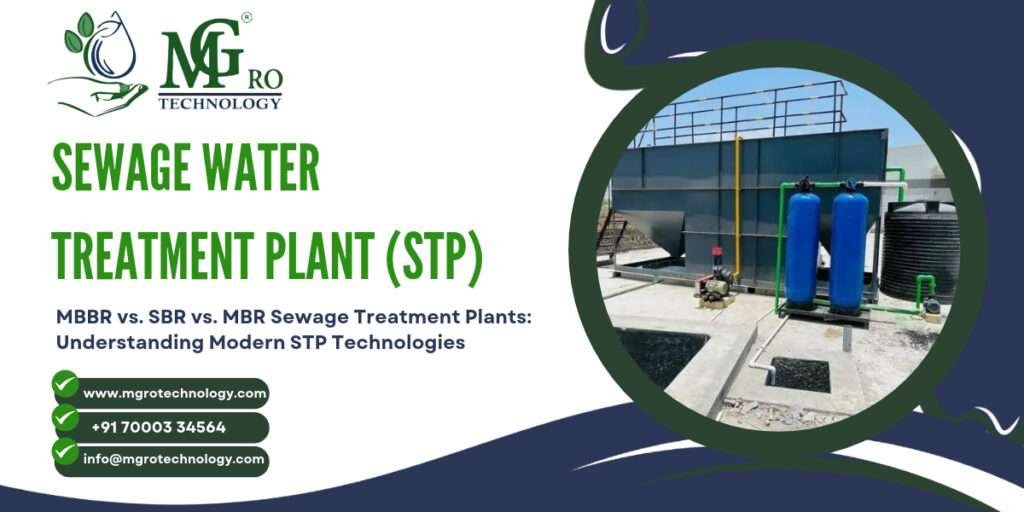
Every industrial campus, factory canteen, administrative block, hospital, hotel, and residential complex generates domestic sewage wastewater. Unlike chemical manufacturing discharge treated in an Effluent Treatment Plant, domestic sewage consists primarily of biodegradable organic matter, suspended solids, nutrients, and pathogens. A Sewage Treatment Plant (STP Plant) purifies this wastewater through controlled biological oxidation so treated water can be safely discharged or reused for gardening, toilet flushing, and utility makeup.
Modern packaged and civil STP Plants rely primarily on three biological treatment technologies: MBBR, SBR, and MBR. This technical guide explains the operating principles and structural characteristics of each technology.
Core Role of Biological Treatment in an STP Plant
Before biological oxidation begins, raw sewage passes through preliminary bar screens and an oil-and-grease trap into an equalization tank where flow fluctuations are balanced. From there, the core biological reactor removes dissolved organic pollutants (measured as BOD and COD) using aerobic microorganisms:
Aerobic Microbial Oxidation: Beneficial bacteria consume dissolved organic waste in the presence of dissolved oxygen supplied by air blowers and fine-bubble diffusers.
Biomass Separation: Once organic pollutants are converted into stable microbial flocs, clean treated water must be separated from biological solids before tertiary filtration and disinfection.
Technology Differentiation: The primary difference among MBBR, SBR, and MBR systems lies in how microorganisms are retained inside the reactor and how treated water is separated from biological sludge.
How MBBR (Moving Bed Biofilm Reactor) Works
MBBR (Moving Bed Biofilm Reactor) is an attached-growth biological process widely used in compact, continuous-flow Sewage Treatment Plants:
Floating Bio-Media Carriers: The aeration tank is filled with specially engineered, high-surface-area polyethylene plastic carriers that remain suspended and continuously circulating through aeration turbulence.
Biofilm Colonization: Beneficial bacteria attach to the protected internal surfaces of these carriers, forming a dense, active biofilm layer capable of digesting high organic loads within a relatively small tank volume.
Downstream Clarification: Because the biofilm remains anchored to the carriers rather than washing out with the water, MBBR systems do not require complex sludge recirculation loops; treated water flows into a downstream tube settler clarifier where sloughed biomass settles before tertiary sand and carbon filtration.
How SBR (Sequencing Batch Reactor) Operates
SBR (Sequencing Batch Reactor) is a fill-and-draw activated sludge process in which equalization, biological aeration, and sedimentation take place sequentially inside a single basin rather than in separate tanks:
Fill & React Phases: Raw sewage enters the reactor while air blowers supply oxygen, allowing suspended aerobic microbes to oxidize organic matter and convert ammonia into nitrate.
Settle Phase: Aeration stops completely, creating a still, quiescent environment where biological sludge settles uniformly to the bottom of the tank without hydraulic turbulence.
Decant & Idle Phases: A motorized or floating decanter draws clear supernatant water from the upper zone for tertiary polishing, while excess settled sludge is periodically wasted.
Nutrient & Batch Control: Programmable logic controls (PLC) regulate cycle timing automatically, making SBR effective for handling variable inflow patterns and achieving biological nutrient reduction.
How MBR (Membrane Bioreactor) Delivers Reuse-Grade Water
MBR (Membrane Bioreactor) combines suspended-growth biological treatment with submerged ultrafiltration hollow-fiber or flat-sheet membranes, eliminating the need for a gravity secondary clarifier and sand filter:
Physical Membrane Barrier: Microscopic membrane pores physically block suspended solids, biological flocs, and virtually all bacteria from passing into the treated water stream.
High Biomass Concentration: Because membranes retain all microorganisms inside the bioreactor, MBR plants operate at a much higher mixed liquor suspended solids (MLSS) concentration, significantly reducing civil or skid footprint.
Superior Permeate Clarity: The resulting crystal-clear, low-turbidity filtrate is immediately suitable for demanding non-potable reuse applications or as high-grade feed water for an Industrial RO Plant.
Choosing the Right STP Technology for Your Project
Selecting between MBBR, SBR, and MBR inside an STP Plant depends on available installation space, automation preference, and treated water end-use:
MBBR Systems: Ideal when simplicity of operation, steady continuous flow, modular MSFRP skid construction, and resilience against shock loads are primary priorities.
SBR Systems: Well suited for facilities with fluctuating diurnal sewage flows, automated batch control, and stringent nitrogen or organic discharge standards.
MBR Systems: Preferred where floor space is severely restricted or where treated sewage water must meet ultra-low turbidity standards for direct cooling tower makeup, HVAC systems, or advanced industrial recycling.
Turnkey Sewage Treatment Plant Manufacturing by MG RO Technology
Every commercial and industrial facility requires a sewage treatment design tailored to its occupancy pattern, available footprint, and water reuse goals. MG RO Technology is an experienced Waste Water Treatment Plant manufacturer engineering custom MSFRP, MSRL, and civil STP Plants across MBBR, SBR, and MBR configurations.
Share your project type, daily sewage generation capacity, and space availability with our engineering team today to receive a tailored STP design and quotation.
 Users Today : 10
 Users This Month : 730
 Total Users : 774