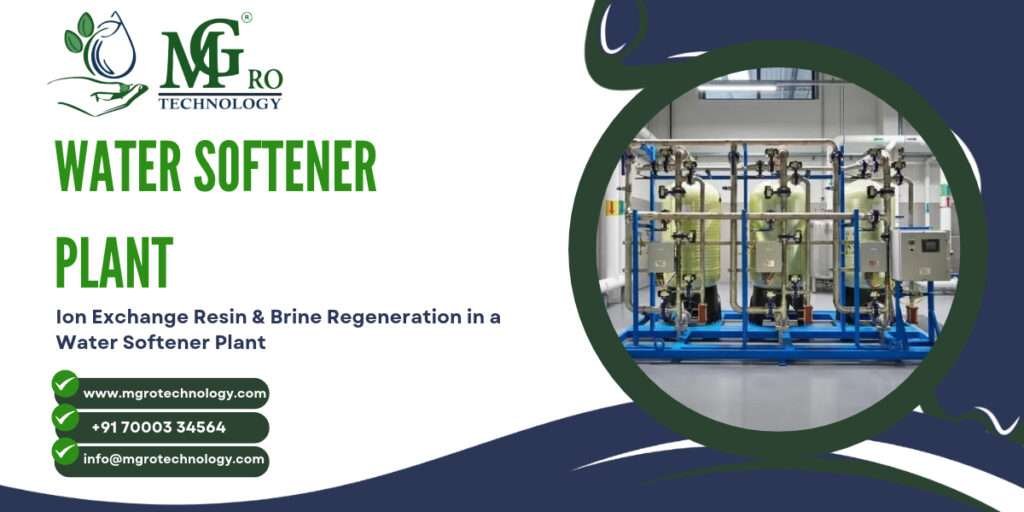
Hard water is one of the most common operational challenges in industrial utilities, commercial buildings, and manufacturing facilities. When calcium and magnesium ions remain dissolved in process or utility water, they precipitate as mineral scale on heating surfaces, pipes, and heat exchangers. A Water Softener Plant addresses this challenge through ion exchange softening and periodic brine regeneration.
This technical guide explains the core theory behind water hardness, how cation exchange resin functions during service, and the conceptual stages of brine regeneration.
Understanding Water Hardness & Why It Matters
In water chemistry, hardness refers primarily to the presence of dissolved multivalent metal cations—most notably calcium and magnesium—alongside minor contributions from other polyvalent ions:
Temporary Hardness (Carbonate Hardness): Associated with bicarbonate ions and tends to precipitate readily when water is heated, forming calcium carbonate scale inside boilers and hot water lines.
Permanent Hardness (Non-Carbonate Hardness): Associated with sulfate, chloride, and nitrate salts that remain dissolved at ambient conditions but still contribute to scaling as water concentrates.
Impact on Industrial Equipment: Scale acts as a thermal insulator and restricts flow area, reducing heat transfer efficiency and increasing energy consumption across a Water Treatment Plant.
How Cation Exchange Resin Removes Water Hardness
Inside a Water Softener Plant, softening relies on ion exchange—a reversible chemical process in which scale-forming ions in the water swap places with non-scaling ions held on synthetic resin beads:
Resin Bead Matrix: Strong acid cation exchange resins consist of microscopic polymer beads containing negatively charged functional sites balanced by exchangeable sodium ions.
Ion Exchange Reaction: As hard water flows downward through the resin bed, calcium and magnesium ions have a stronger chemical affinity for the exchange sites than sodium ions, so they attach to the resin while sodium ions are released into the water.
Softened Water Output: Because sodium salts remain highly soluble across normal industrial temperature and concentration ranges, the resulting softened water does not form conventional calcium or magnesium scale.
Brine Regeneration Cycle Explained
Over time, the exchange sites on the resin bed become occupied by calcium and magnesium ions, exhausting the resin’s softening capacity. Regeneration reverses the exchange process by exposing the resin to a high concentration of sodium chloride (salt) brine:
Backwash: Upward water flow lifts and expands the resin bed, loosening trapped suspended solids and reclassifying the resin media to prevent channeling.
Brine Draw (Slow Injection): A concentrated salt brine solution drawn from the brine tank passes slowly through the resin bed, flooding it with a high concentration of sodium ions that displace captured calcium and magnesium ions back into solution.
Slow Rinse: Clean water flushes residual brine slowly through the resin bed so displacement completes uniformly without washing away exchanged hardness ions prematurely.
Fast Rinse: Higher-flow water rinses remaining brine and hardness ions out of the vessel until outlet water quality is ready for normal service.
Relationship Between Water Softening, RO & Plant Utilities
While a Water Softener Plant is highly effective at removing hardness ions, it does not remove dissolved sodium salts or reduce overall Total Dissolved Solids (TDS):
Hardness Removal vs. TDS: Exchanging one divalent calcium ion for two monovalent sodium ions actually leaves total dissolved ionic charge essentially unchanged, meaning softening is distinct from desalination in an Industrial RO Plant.
Protecting Downstream Membranes: In certain high-hardness water applications, softening upstream of an Industrial RO Plant helps prevent calcium carbonate or calcium sulfate scaling on Industrial RO Membranes.
Utility Water Conditioning: Softened water is widely used for boiler feed makeup, cooling tower water conditioning, laundry, and manufacturing processes where scale-free surfaces are essential.
Custom Water Softener Plant Solutions by MG RO Technology
Selecting the right resin grade, vessel configuration, and regeneration control setup depends on raw water hardness profile and continuous operational demand. MG RO Technology designs and manufactures reliable Water Softener Plants engineered for consistent hardness removal and straightforward operation.
Share your raw water hardness details and plant flow requirements with our engineering team today to receive a tailored system recommendation and quotation.
 Users Today : 13
 Users This Month : 743
 Total Users : 787