
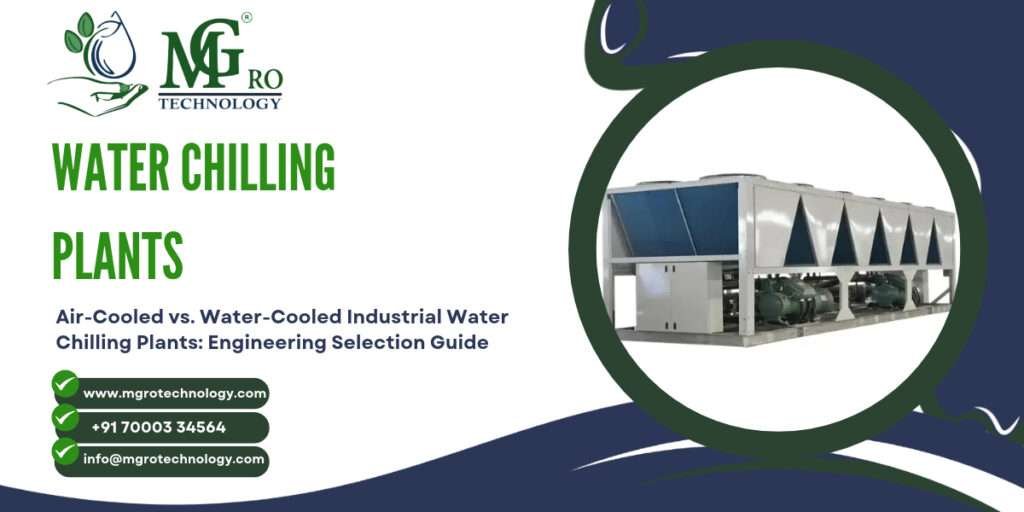
Consistent process temperature control is essential in plastic injection moulding, chemical reactor cooling, pharmaceutical processing, dairy and beverage production, and printing machinery. An Industrial Water Chiller removes unwanted heat from manufacturing equipment by circulating chilled water through a closed or open process loop.
When specifying a Chilling Plant, the primary architectural choice is between an air-cooled system and a water-cooled system. This technical guide explains the refrigeration principles, heat rejection mechanisms, and selection factors governing both configurations.
Core Refrigeration Principle of an Industrial Water Chiller
Regardless of condenser design, every vapor-compression Industrial Water Chiller operates through four continuous thermodynamic stages:
Evaporation (Heat Absorption): Low-pressure liquid refrigerant absorbs heat from warm return process water inside the evaporator (plate heat exchanger or shell-and-tube chiller), cooling the water down to the required setpoint temperature.
Compression: The compressor raises the pressure and temperature of the refrigerant vapor so heat can be released outside the process loop.
Condensation (Heat Rejection): High-pressure refrigerant vapor passes through the condenser, releasing absorbed heat into either ambient air or cooling tower water and condensing back into a liquid.
Expansion: An expansion valve reduces refrigerant pressure and temperature before it re-enters the evaporator to repeat the cooling cycle.
The fundamental difference between air-cooled and water-cooled chillers lies in the condensation stage—specifically, how heat is rejected from the refrigerant.
How an Air-Cooled Industrial Water Chiller Rejects Heat
An air-cooled Water Chiller uses ambient air passing across finned copper-aluminum condenser coils to remove heat from the refrigerant:
Self-Contained Package Design: Built as a single integrated skid containing the compressor, evaporator, air-cooled condenser coil, axial condenser fans, insulated water tank, and circulation pump.
Zero Cooling Tower Requirement: Because heat is rejected directly to the atmosphere, air-cooled systems eliminate the need for cooling towers, condenser water pumps, and evaporative makeup water pipelines.
Installation & Ventilation Considerations: Air-cooled units require unobstructed airflow and adequate exhaust ventilation so hot air discharged from the condenser fans does not recirculate back into the coil intake.
How a Water-Cooled Water Chilling Plant Operates
A water-cooled Industrial Water Chilling Plant rejects refrigerant heat into a secondary closed or open water circuit connected to an external cooling tower:
Shell-and-Tube or Brazed Plate Condenser: Warm refrigerant transfers thermal energy to circulating condenser water inside a compact heat exchanger rather than relying on large finned air coils.
Evaporative Cooling Tower Integration: Heated condenser water is pumped to an outdoor cooling tower, where evaporative cooling lowers the water temperature before returning it to the chiller condenser.
Condenser Water Quality Management: Because open cooling towers evaporate pure water and concentrate dissolved minerals, conditioning makeup water through a Water Softener Plant prevents calcium scale buildup inside condenser tubes and preserves heat transfer efficiency.
Key Factors Governing Chiller Selection
Choosing between an air-cooled and a water-cooled Water Chilling Plant depends on site infrastructure, thermal load, and ambient operating conditions:
Ambient Temperature Conditions: Water-cooled condensers operate based on ambient wet-bulb temperature rather than dry-bulb air temperature, allowing stable head pressure and high thermodynamic efficiency even in hot industrial climates.
Available Plant Space & Utility Infrastructure: Air-cooled chillers are straightforward to install where water conservation is critical or roof/outdoor cooling tower space is unavailable, whereas water-cooled systems occupy less indoor mechanical room floor space for high-tonnage installations.
Process Water Purity Integration: In food, beverage, and pharmaceutical lines where chilled water directly contacts product vessels or purified formulations, chillers are frequently paired with an upstream Industrial RO Plant and stainless steel wetted components.
Compressor Architecture: Smaller to mid-sized chilling plants typically utilize multiple hermetic scroll compressors for staged part-load reliability, while heavy continuous-duty industrial chilling plants incorporate semi-hermetic screw compressors.
Custom Industrial Water Chilling Plants by MG RO Technology
Selecting the right refrigeration configuration ensures stable process temperatures, lower power consumption, and uninterrupted production shifts. MG RO Technology manufactures heavy-duty air-cooled and water-cooled Industrial Water Chillers and Water Chilling Plants engineered for demanding industrial environments.
Share your application process, required chilled water temperature, and cooling load details with our engineering team today to receive a customized chilling plant specification and quotation.
 Users Today : 0
 Users This Month : 730
 Total Users : 774