
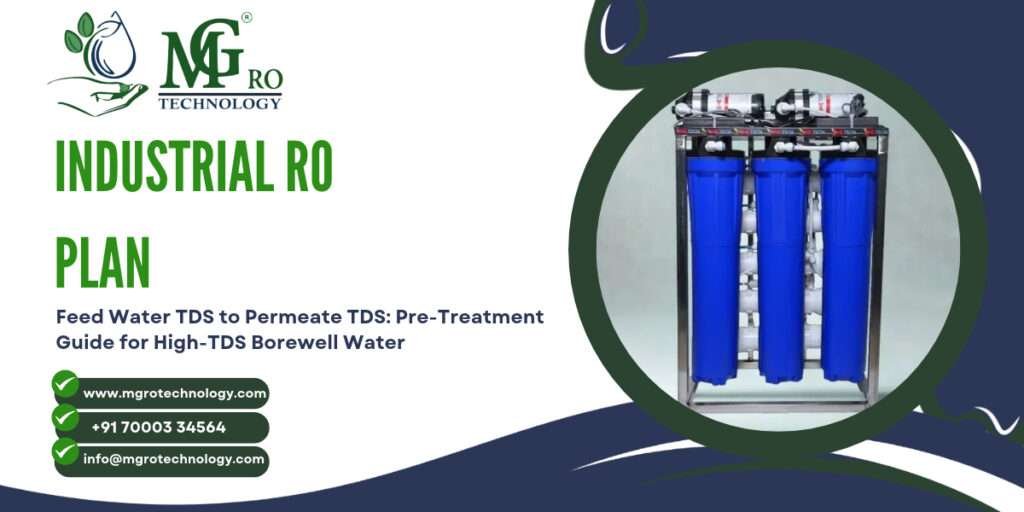
Ground borewell water is the primary raw water source for most manufacturing units, commercial complexes, and processing plants. However, borewell water rarely enters an Industrial RO Plant in ready-to-filter condition. Elevated Total Dissolved Solids (TDS), calcium and magnesium hardness, dissolved iron, suspended silt, and reactive silica can rapidly foul semi-permeable membranes and degrade treated water purity.
This technical guide explains how raw borewell water chemistry influences permeate TDS, the core pre-treatment stages required ahead of reverse osmosis, and when a two-pass RO configuration becomes necessary.
How Raw Borewell TDS, Hardness, Iron & Silica Affect RO Performance
Reverse osmosis membranes are engineered to reject dissolved ionic salts, not suspended particles or oxidizing chemicals. When untreated borewell water enters an Industrial RO Plant, several parameters directly govern system stability and permeate quality:
Total Dissolved Solids (TDS): Higher feed TDS increases the natural osmotic pressure of the water, requiring higher feed pump operating pressure to force pure water molecules across the membrane barrier.
Calcium & Magnesium Hardness: As water concentrates inside the membrane housing, dissolved hardness salts tend to precipitate onto the membrane surface, creating hard mineral scale.
Dissolved Iron & Manganese: Soluble ferrous iron oxidizes upon exposure to air or chlorine, forming insoluble rust precipitates that clog membrane feed spacers within days.
Turbidity & Suspended Silt: Fine clay, sand, and organic colloids block microscopic membrane pores and increase differential pressure across stages.
Reactive Silica: Elevated silica levels limit maximum safe recovery and form stubborn, glass-like deposits if not managed during pre-treatment.
Essential Pre-Treatment Stages Before the RO Skid
Every reliable Water Treatment Plant uses a structured sequence of pre-treatment units to condition raw borewell water before it reaches the high-pressure RO pump:
Iron Removal or Oxidation Filtration (When Required): If borewell water contains elevated iron, aeration or catalytic oxidation media filters out oxidized iron particles before downstream filtration.
Multi-Grade Sand Filter (MGF): Layered quartz sand and gravel media trap suspended solids, turbidity, and coarse particulate matter down to fine micron levels.
Activated Carbon Filter (ACF): Granular activated carbon adsorbs free chlorine, organic compounds, color, and odor that would otherwise oxidize and permanently damage polyamide Industrial RO Membranes.
Upstream Ion-Exchange Softening (For Very Hard Water): When feed water exhibits excessive calcium and magnesium hardness, an upstream Water Softener Plant replaces scale-forming hardness ions with soluble sodium ions.
Antiscalant & pH Dosing System: Precision chemical dosing keeps sparingly soluble mineral salts dispersed in solution so they exit cleanly with the reject stream.
Micron Cartridge Filter (5-Micron & 1-Micron): Acts as the final physical barrier ahead of the high-pressure pump, capturing any fine media fines or suspended particles.
Ultrafiltration (UF) Pre-Treatment (For High-Turbidity Sources): Hollow-fiber UF membranes provide an absolute barrier against colloidal silt, bacteria, and high Silt Density Index (SDI) water.
Expected Permeate TDS Based on Feed Water Chemistry
In reverse osmosis theory, permeate TDS is determined by the salt rejection capability of the membrane and the dissolved ion profile of the feed water rather than a single fixed output number:
Salt Rejection Characteristics: Modern thin-film composite brackish water membranes reject the vast majority of dissolved multivalent ions (such as calcium, magnesium, and sulfate) and a high percentage of monovalent ions (such as sodium and chloride).
Impact of Feed Water Temperature & Pressure: Higher feed water temperatures slightly increase salt passage through the polymer matrix, whereas operating within optimal feed pressure maintains high solute rejection.
Effect of Membrane Age & Fouling: Clean, properly maintained membranes deliver consistent low-TDS permeate, while scaled or oxidized membranes allow progressively higher salt passage into the product line.
Single-Pass vs. Two-Pass Industrial RO Configurations
Depending on the end-use purity required by your manufacturing process, an Industrial RO Plant is configured as either a single-pass or two-pass system:
Single-Pass Industrial RO Plant: Raw pre-treated water passes through one complete reverse osmosis array. This configuration meets the water quality requirements of general manufacturing, cooling tower makeup, beverage dilution, commercial utilities, and low-pressure boiler feed.
Two-Pass Industrial RO Plant: Permeate from the first RO pass is routed directly as feed water into a second RO stage for further polishing. Two-pass systems are selected when raw borewell TDS is unusually high or when industries—such as pharmaceuticals, electronics, specialty chemicals, and high-pressure steam boilers—require ultra-low conductivity water.
Need a Pre-Treatment & RO System Engineered for Your Borewell Water?
Building an Industrial RO Plant without matching pre-treatment to raw borewell chemistry leads to frequent membrane replacement and unplanned downtime. MG RO Technology designs complete, turnkey filtration and reverse osmosis systems based on your exact lab water analysis.
Share your borewell water test report and hourly capacity requirement with our engineering team today for a customized pre-treatment and RO system proposal.
 Users Today : 7
 Users This Month : 671
 Total Users : 715