
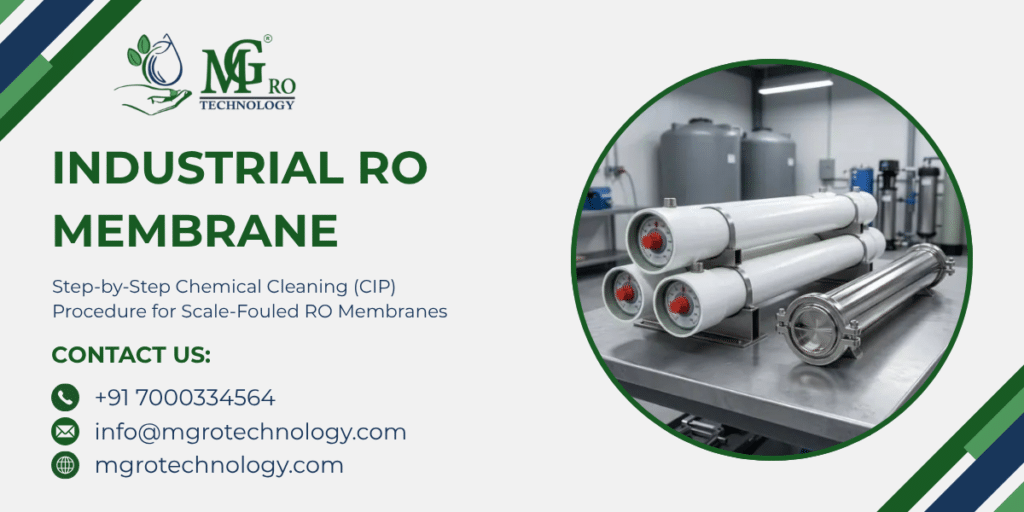
In continuous chemical manufacturing, thermal power stations, pharmaceutical purified water loops, and heavy processing industries, high-efficiency membrane separation systems operate under demanding chemical conditions. Over extended operational cycles, sparingly soluble mineral salts precipitate onto microscopic membrane pores, forming dense inorganic scale layers that restrict hydraulic passage.
Restoring baseline flux performance and salt rejection efficiency depends fundamentally on maintaining a high-performance Industrial RO Membrane element.
An industrial reverse osmosis element incorporates polyamide thin-film composite layers, porous polysulfone support structures, feed channel spacers, and permeate collection tubes designed to separate dissolved ions from aqueous solutions.
Neglecting inorganic scale accumulation or attempting aggressive, uncoordinated chemical cleaning on scaling-damaged elements leads to irreversible membrane polymer oxidation, permanent mechanical pore enlargement, severe pressure drop spikes, premature element replacement, and high operating costs. Understanding the theoretical principles governing low-pH acid dissolution, chelation reactivity, temperature-dependent reaction kinetics, and low-pressure flushing velocities enables plant engineers to execute effective restoration cycles. This comprehensive technical guide provides an in-depth theoretical analysis of Clean-in-Place (CIP) principles for scale-fouled reverse osmosis membranes.
Theoretical Kinetics of Inorganic Scale Dissolution
Clean-in-Place procedures rely on targeted chemical reactions to break down mineral crystal matrices without damaging delicate polymer membrane surfaces:
+-----------------------------------------------------------------+
|                   INORGANIC SCALE CRYSTAL DEPOSITION            |
| (Calcium carbonate, sulfate, or silica scales block membrane)  |
+-----------------------------------------------------------------+
                                  |
                                  v
+-----------------------------------------------------------------+
|               LOW-pH DISSOLUTION & CHELATION REACTION           |
| (Acidic CIP solutions solubilize minerals & bind metal cations) |
+-----------------------------------------------------------------+
                                  |
                                  v
+-----------------------------------------------------------------+
|             LOW-PRESSURE FLUSHING & DISLODGED FOULANT SWEEP     |
| (Recirculated fluid velocity sweeps dissolved scale to drain)   |
+-----------------------------------------------------------------+
1. Acid-Base Equilibrium and Mineral Solubilization
Theoretical Principle: Inorganic scales such as calcium carbonate precipitate when local ion concentrations exceed solubility thresholds. Introducing a controlled low-pH acidic CIP solution shifts the chemical equilibrium, converting insoluble carbonate ions into soluble bicarbonate species and dissolving the scale matrix.
Chelation Chemistry: For stubborn sulfate scales like calcium sulfate or barium sulfate, organic chelating agents are incorporated. These molecules bind strongly with divalent mineral cations, pulling them out of the crystalline lattice and holding them in soluble aqueous complexes.
2. Low-Shear Hydraulic Recirculation and Dissolved Sweep Mechanics
Theoretical Principle: Chemical cleaning solutions must be recirculated across the membrane surface at low hydraulic pressures and controlled cross-flow velocities. High feed pressure must be avoided during CIP to prevent compressing dislodged scale particles into active membrane pores.
Temperature and Contact Time Dynamics: Elevating solution temperature increases molecular reaction kinetics and speeds up scale dissolution rates. However, thermal levels must remain strictly within polymer tolerance limits to prevent structural membrane degradation.
Comprehensive Theoretical Stages of the CIP Process
Executing a successful membrane cleaning cycle involves four distinct theoretical stages designed to dissolve and remove foulants systematically:
Initial Low-Pressure Permeate Flush Stage: Clean permeate water is recirculated through the pressure vessels at low pressure to displace concentrated raw feed brine and loose foulant particles before introducing chemical reagents.
Low-pH Acidic Chemical Soak Stage: An engineered low-pH acidic cleaning solution containing specialized chelating agents is introduced into the membrane array. Static soak periods allow the chemical reagents to penetrate deep into dense mineral scale matrices and break ionic bonds.
High-Velocity Recirculation and Dissolution Stage: The cleaning solution is recirculated through the pressure vessels at optimized cross-flow velocities. The turbulent hydraulic action sweeps dissolved mineral ions and dislodged foulant fragments off the membrane surface into the cleaning tank.
Final High-Purity Rinsing Stage: High-purity permeate water is flushed through the system until residual chemical cleaning agents are completely removed and feed-to-reject pH levels equalize, ensuring safe return to normal operation.
System Integration Across Industrial Water Treatment Infrastructure
Industrial reverse osmosis membrane elements operate as the core separation technology within an integrated water treatment facility:
Primary Membrane Separation: High-purity product water generation and salt rejection depend on an engineered Industrial RO Plant.
High-Performance Separation Elements: Long-term filtration stability requires selecting a premium Industrial RO Membrane suited to feed water chemistry.
Hardness Removal & Scale Prevention: Pre-treating raw water with a high-capacity Water Softener Plant eliminates calcium and magnesium scaling risks prior to membrane entry.
Industrial Wastewater Recycling: Process wastewater streams are treated and reclaimed using advanced Effluent Treatment Plant and Sewage Treatment Plant systems.
Thermal Regulation & Water Cooling: Precise operating fluid temperatures are maintained across industrial processes using a heavy-duty Industrial Water Chiller.
Comprehensive Turnkey Manufacturing: System integration, skid fabrication, and custom engineering are executed by an experienced Water Treatment Plant MFG.
Theoretical Best Practices for CIP Execution
To maximize cleaning effectiveness and protect membrane elements from chemical damage, system engineers follow three core theoretical guidelines:
Initiate Cleaning at Low Performance Drift Thresholds: Execute CIP procedures when normalized permeate flow drops or differential pressure increases by modest margins, preventing scale from hardening into irreversible crystalline structures.
Monitor Cleaning Solution pH and Turbidity Continuously: Track cleaning solution pH during recirculation; a rapid rise in acid solution pH indicates active scale neutralization, requiring chemical replenishment to maintain effective dissolution kinetics.
Always Clean Stages Independently: Clean multi-stage membrane vessel arrays in separate hydraulic loops to prevent dislodged foulants from first-stage vessels from plugging downstream second-stage membrane feed channels.
Conclusion
Understanding the theoretical principles of Clean-in-Place procedures is essential for restoring scale-fouled reverse osmosis membranes and extending their operational lifespan. By applying targeted acid dissolution kinetics, utilizing chelating chemistry, and maintaining low-pressure cross-flow recirculation, industrial facilities eliminate mineral scale deposition and preserve high-efficiency water treatment performance.
Looking for Premium Industrial Water Treatment and Filtration Solutions? Explore our complete range of high-efficiency Industrial RO Plant setups, advanced Industrial RO Membrane options, heavy-duty Water Softener Plant units, industrial Effluent Treatment Plant and Sewage Treatment Plant installations, precise Industrial Water Chiller systems, and custom engineering from a leading Water Treatment Plant MFG at MGRO Technology. Contact our expert engineering team today.
 Users Today : 6
 Users This Month : 726
 Total Users : 770