
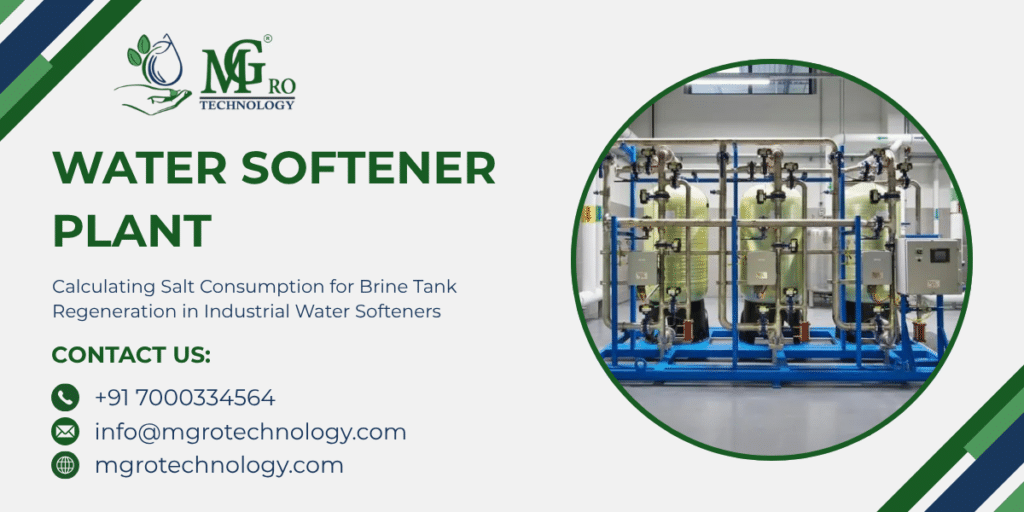
In commercial laundry operations, textile dyeing facilities, chemical manufacturing plants, and industrial boiler feedwater systems, hardness ions present significant operational challenges. Dissolved calcium and magnesium cations form insoluble mineral scale deposits when subjected to thermal energy, restricting fluid flow and destroying heat transfer efficiency across plant infrastructure.
Preventing hardness-related scaling depends fundamentally on continuous operation of a high-capacity Water Softener Plant.
An industrial ion-exchange water softener utilizes strong acid cation resin beads, co-current or counter-current multi-port control valves, pressure vessel tanks, and a concentrated sodium chloride brine reservoir to continuously swap hardness ions for non-scaling sodium ions.
Operating an industrial water softener without optimizing brine tank salt consumption leads to incomplete resin regeneration, early hardness leakage, excessive salt wastage, high operating expenditure, and premature resin bead exhaustion. Understanding the core theoretical principles governing mass-action equilibria, sodium ion exchange kinetics, saturated brine dissolution rates, and stoichiometric regeneration requirements allows plant engineers to maintain peak resin capacity efficiently. This comprehensive technical guide provides an in-depth theoretical analysis of salt consumption dynamics during brine tank regeneration in industrial water softeners.
Theoretical Kinetics of Ion Exchange and Brine Regeneration
Water softening relies on reversible ion exchange chemistry, exchanging divalent hardness cations for monovalent sodium ions across synthetic resin matrix sites:
+-----------------------------------------------------------------+
|                   EXHAUSTED CATION RESIN BED                    |
| (Resin exchange sites fully saturated with Calcium & Magnesium) |
+-----------------------------------------------------------------+
                                  |
                                  v
+-----------------------------------------------------------------+
|               HIGH-CONCENTRATION BRINE INJECTION                |
| (Concentrated Sodium ions force mass-action displacement)       |
+-----------------------------------------------------------------+
                                  |
                                  v
+-----------------------------------------------------------------+
|             REGENERATED SODIUM-FORM RESIN MATRIX                |
| (Hardness cations desorbed to waste; resin capacity restored)   |
+-----------------------------------------------------------------+
1. Mass-Action Equilibrium and Displacement Kinetics
Theoretical Principle: Strong acid cation resin beads possess a natural thermodynamic preference for multivalent ions like calcium and magnesium over monovalent sodium ions. During service, incoming hardness cations easily displace sodium ions from functional sulfonic acid exchange sites.
Reversal via Mass Action: To reverse this natural affinity during regeneration, a high concentration of sodium ions in saturated brine solution must be introduced. The overwhelming chemical mass action forces hardness cations off the resin matrix, replacing them with fresh sodium ions.
2. Brine Saturation Dynamics and Salt Efficiency Curve
Theoretical Principle: The efficiency of salt utilization is non-linear. At lower salt dosage levels per unit volume of resin, a higher percentage of the applied sodium salt is actively utilized for ion exchange, yielding high salt efficiency.
Diminishing Returns: Increasing salt dosage achieves higher total exchange capacity and lowers residual hardness leakage, but at the expense of lower salt efficiency. Finding the optimal theoretical balance between salt consumption and operating capacity is essential for economic plant performance.
In-Depth Analysis of Regeneration Parameters
Evaluating core theoretical parameters determines how salt consumption impacts resin bed restoration:
Stoichiometric Sodium Requirements: The theoretical mass of sodium chloride required to regenerate a exhausted resin bed depends directly on the total equivalent chemical charge of captured calcium and magnesium ions.
Brine Concentration and Contact Time: Optimal ion exchange displacement kinetics require introducing brine at controlled concentration levels and controlled contact velocities, ensuring uniform fluid distribution across the resin bed without channelling.
Co-Current vs. Counter-Current Regeneration: In co-current regeneration, brine flows in the same direction as service water, requiring higher total salt consumption to push residual hardness ions down through the entire bed. Counter-current regeneration introduces brine in the opposite direction, regenerating the polished exit layer first with minimal salt usage.
Slow Rinse Displacement Mechanics: Following brine draw, a low-velocity slow rinse sweeps remaining concentrated brine through the resin matrix, completing exchange reactions before high-velocity fast rinsing clears residual sodium salts to drain.
System Integration Across Industrial Water Treatment Infrastructure
Industrial water softeners operate as vital pre-treatment infrastructure across integrated industrial process networks:
Primary Hardness Removal: Calcium and magnesium extraction is performed through a high-capacity Water Softener Plant.
Downstream Membrane Protection: Softener effluent protects high-rejection elements in an Industrial RO Plant and premium Industrial RO Membrane from inorganic mineral scaling.
Wastewater Treatment Integration: Softened water usage minimizes scaling across downstream Effluent Treatment Plant and Sewage Treatment Plant installations.
Thermal System Protection: Hardness-free water feed prevents scale deposition inside an Industrial Water Chiller and process boiler loops.
Comprehensive Turnkey Manufacturing: System design, pressure vessel fabrication, and valve integration are delivered by a trusted Water Treatment Plant MFG.
Theoretical Best Practices for Brine Management
To optimize salt consumption and maximize resin operational lifespan in industrial water softening systems, design engineers follow three core theoretical guidelines:
Implement Counter-Current Regeneration Architecture: Specify counter-current brine draw cycles to minimize salt dosage requirements while achieving lower operating hardness leakage levels.
Maintain Saturated Brine Dissolution Standards: Ensure brine tanks maintain adequate salt bed depth and contact time to guarantee full 100% saturation before injection into the resin bed.
Purity Control of Regeneration Salt: Use high-purity sodium chloride evaporated salt blocks or pellets free from insoluble matter, iron, and silica to prevent resin bed fouling and brine valve plugging.
Conclusion
Understanding the theoretical kinetics of salt consumption and mass-action regeneration is essential for operating cost-effective industrial water softeners. By optimizing brine saturation levels, balancing salt dosage against operating capacity, and utilizing counter-current regeneration cycles, industrial facilities ensure continuous zero-hardness water supply while minimizing salt expenditure.
Looking for Premium Industrial Water Treatment and Filtration Solutions? Explore our complete range of high-capacity Water Softener Plant units, high-efficiency Industrial RO Plant setups, advanced Industrial RO Membrane options, industrial Effluent Treatment Plant and Sewage Treatment Plant installations, precise Industrial Water Chiller systems, and custom engineering from a leading Water Treatment Plant MFG at MGRO Technology. Contact our expert engineering team today.
 Users Today : 13
 Users This Month : 743
 Total Users : 787