
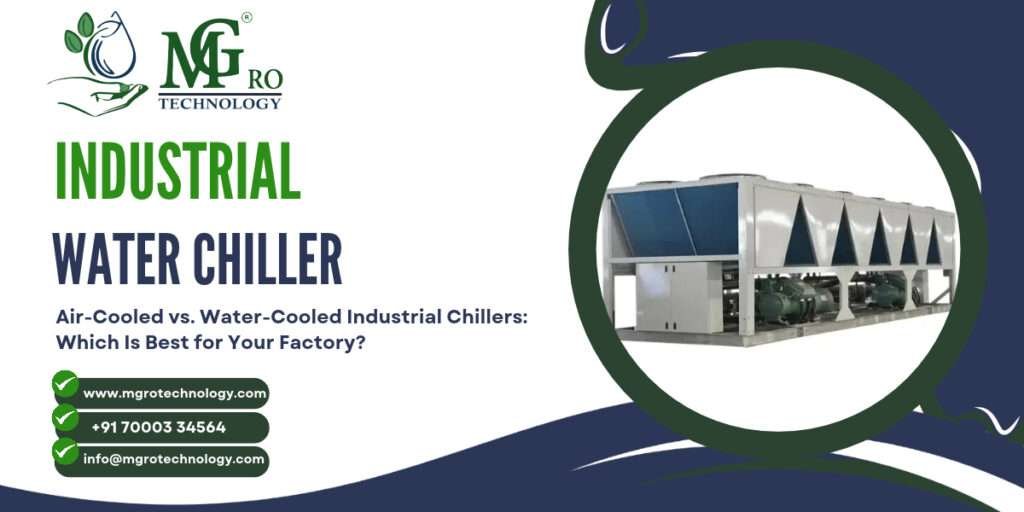
In industrial manufacturing facilities—spanning plastic injection molding, chemical processing, pharmaceutical production, and metal fabrication—removing process heat continuously is vital for product quality and machine longevity. Selecting the right Industrial Water Chiller is a core engineering decision that dictates long-term energy efficiency, operational footprint, and utility costs.
Industrial chillers primarily fall into two categories based on how they reject heat absorbed from process machinery: Air-Cooled Chillers and Water-Cooled Chillers.
While both systems utilize a standard vapor-compression refrigeration cycle to chill recirculating process water, their heat rejection architectures differ fundamentally. Understanding these differences enables plant managers and utility engineers to choose the optimal configuration for their site conditions.
1. Structural Architecture & Heat Rejection Mechanisms
The primary architectural difference between air-cooled and water-cooled chillers lies in the condenser design and how thermal energy is discharged into the environment.
+-------------------------------------------------------------------------+
|                  HEAT REJECTION METHOD COMPARISON                       |
+-------------------------------------------------------------------------+
| Air-Cooled Chiller: Refrigerant -> Finned Condenser Coil -> Ambient Air |
|                     (Blows heat directly into surrounding air)          |
|                                                                         |
| Water-Cooled Chiller: Refrigerant -> Shell-and-Tube Condenser -> Water  |
|                       (Pumps heat to an external Cooling Tower)         |
+-------------------------------------------------------------------------+
Air-Cooled Industrial Chillers
Air-cooled chillers utilize air-cooled condenser coils composed of copper tubes wrapped with thin aluminum fins, paired with large motorized axial fans.
Operating Mechanism: Hot, high-pressure refrigerant gas flows through the finned coils. Outdoor or ambient air is drawn across the coils by the fans, absorbing heat directly from the refrigerant and releasing it into the surrounding atmosphere.
System Footprint: Highly self-contained and packaged. Air-cooled units require no external water infrastructure, such as cooling towers or dedicated condenser water pumps.
Water-Cooled Industrial Chillers
Water-cooled chillers utilize shell-and-tube heat exchangers (or plate heat exchangers) as their condensers.
Operating Mechanism: Hot refrigerant gas flows through the condenser shell while cold water from an external evaporative cooling tower recirculates through internal tubes. The water absorbs the refrigerant’s heat and pumps it to the cooling tower, where it is rejected to the atmosphere via evaporation.
System Footprint: Requires a connected cooling tower loop, raw water supply lines, and dedicated condenser water pumps.
2. Feature Comparison Matrix
+-------------------------------------------------------------------------+
|                   CHILLER SELECTION COMPARISON MATRIX                   |
+-------------------------------------------------------------------------+
| Parameter            | Air-Cooled Chiller       | Water-Cooled Chiller  |
+----------------------+--------------------------+-----------------------+
| Heat Rejection       | Ambient Air via Fans     | Recirculating Water   |
| Mechanism            |                          | via Cooling Tower     |
|                      |                          |                       |
| Electrical           | Higher (Relies on high   | Lower (Water heat     |
| Efficiency           | ambient air temp)        | transfer is superior) |
|                      |                          |                       |
| Water Consumption    | Zero water consumption   | Requires continuous   |
|                      | in condenser loop        | cooling tower makeup  |
|                      |                          |                       |
| Maintenance Load     | Low (Clean fan blades    | Higher (Requires scale|
|                      | & coils periodically)    | & corrosion treatment)|
|                      |                          |                       |
| Physical Placement   | Outdoor / Well-ventilated| Indoor Plant Room     |
|                      | roof space               | (Cooling tower outside)|
+----------------------+--------------------------+-----------------------+
3. Key Selection Factors for Manufacturing Plants
+-------------------------------------------------------------------------+
|                        CHILLER SELECTION DECISION                       |
+-------------------------------------------------------------------------+
| Site Constraints: Limited water availability, high maintenance costs,   |
|                   small-to-medium cooling capacity needs.               |
| RECOMMENDED CHOICE -> Air-Cooled Industrial Chiller                     |
|                                                                         |
| Site Constraints: Abundant water, indoor machine room, large multi-ton   |
|                   continuous manufacturing cooling requirements.        |
| RECOMMENDED CHOICE -> Water-Cooled Industrial Chiller                   |
+-------------------------------------------------------------------------+
A. Energy Efficiency & Ambient Temperatures
Water has a significantly higher heat transfer capacity than air. Because evaporative cooling towers operate based on ambient wet-bulb temperature (which is lower than dry-bulb air temperature), water-cooled chillers operate at lower condensing pressures. This allows the compressor to consume less electrical power per ton of cooling, making water-cooled systems the most energy-efficient choice for medium-to-large industrial facilities.
B. Water Quality & Auxiliary Treatment Needs
Air-Cooled: Consumes no water for heat rejection, completely eliminating scaling, algae growth, or chemical treatment needs in the condenser circuit.
Water-Cooled: Relies on evaporative cooling towers that continuously lose pure water to evaporation, concentrating dissolved raw water minerals. To protect water-cooled condensers from scale buildup and tube erosion, makeup water must pass through a high-efficiency Water Softener Plant or an Industrial RO Plant.
C. Installation Location & Space Constraints
Air-cooled units must be placed outdoors (on rooftops or open ground pads) with ample airflow to prevent heat recirculation. Water-cooled chillers can be housed neatly inside an indoor utility room, requiring only external piping connections to a roof-mounted or ground-level cooling tower.
Summary of Best Practices
If your factory operates in a water-scarce area, prefers minimal ongoing maintenance, or needs small-to-medium cooling capacity, an Air-Cooled Chiller provides a reliable, self-contained solution. If your facility operates large-scale continuous manufacturing lines and prioritizes maximum electrical power savings, a Water-Cooled Chiller paired with a proper water softening system is the ideal engineering investment.
Explore complete process cooling options featuring custom Water Softener Plants, high-recovery Industrial RO Plants, and integrated Effluent Treatment Plants (ETP).
Consult with MGRO Technology Cooling Engineers
Unsure whether an air-cooled or water-cooled chiller layout fits your facility’s heat load and water infrastructure?
MGRO Technology designs, manufactures, and services high-efficiency process cooling systems, Water Softener Plants, Industrial RO Plants, and industrial water treatment systems engineered for factory performance.
Contact MGRO Technology Engineers Today to request a process heat load assessment and equipment proposal.
 Users Today : 6
 Users This Month : 726
 Total Users : 770