
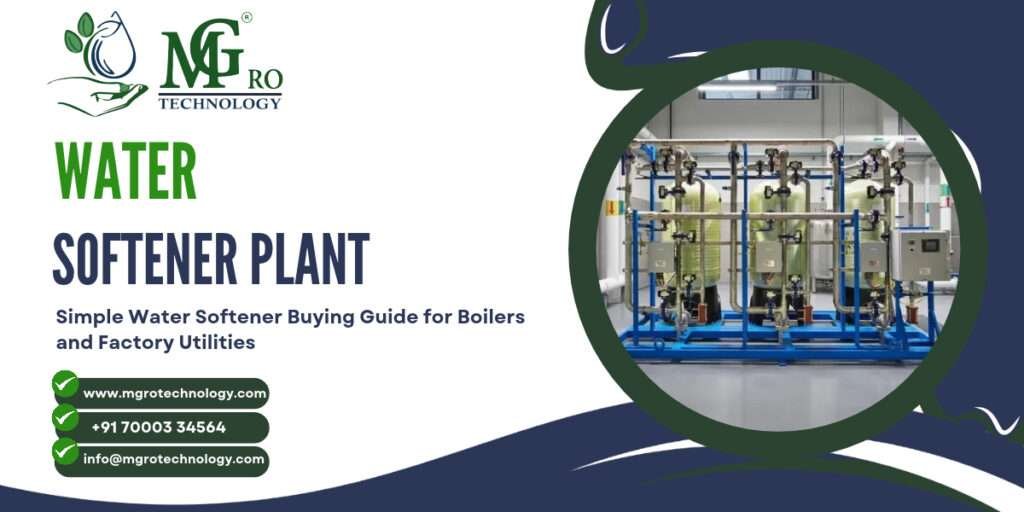
Hard water is one of the most persistent operational threats facing industrial manufacturing units, commercial facilities, and processing plants. Feedwater containing high levels of dissolved calcium and magnesium minerals causes rapid mineral scale buildup inside industrial boilers, heat exchangers, cooling towers, and utility piping.
In high-temperature environments like boilers, even a paper-thin layer of scale acts as a severe thermal insulator. This forces boilers to consume significantly more fuel to produce the same volume of steam, dramatically increases utility bills, and risks tube overheating, rupture, and catastrophic equipment failure.
Installing an industrial Water Softener Plant is the standard, high-efficiency engineering solution to eliminate hardness ions before raw water enters critical utility circuits.
1. How Industrial Water Softening Works (Ion Exchange Mechanism)
Unlike reverse osmosis plants that remove virtually all dissolved ions, a classic industrial water softener targets divalent scale-forming hardness ions ($\text{Ca}^{2+}$ and $\text{Mg}^{2+}$) through a reversible chemical reaction called Ion Exchange.
+-------------------------------------------------------------------------+
|                  ION EXCHANGE SOFTENING MECHANISM                       |
+-------------------------------------------------------------------------+
| Hard Feed Water ($\text{Ca}^{2+}$ / $\text{Mg}^{2+}$) enters vessel packed with resin |
|                                                                         |
|                                    |                                    |
|                                    v                                    |
| Resin beads capture $\text{Ca}^{2+}$ / $\text{Mg}^{2+}$ and release soft $\text{Na}^{+}$ ions   |
|                                                                         |
|                                    |                                    |
|                                    v                                    |
| Exhausted resin is regenerated using a concentrated Salt Brine ($\text{NaCl}$) solution |
+-------------------------------------------------------------------------+
Service Cycle: Raw hard water enters a pressure vessel packed with strong acid cation (SAC) synthetic polymer resin beads charged with active sodium ions ($\text{Na}^{+}$). As water passes through the resin bed, the resin beads exhibit a stronger chemical affinity for calcium and magnesium ions than sodium. The resin captures the hardness minerals and releases non-scaling sodium ions into the treated water stream.
Resin Exhaustion: Once all active exchange sites on the resin beads are occupied by calcium and magnesium ions, the softening capacity is exhausted, and hardness minerals begin to break through into the output stream.
Brine Regeneration: The system undergoes automated or manual regeneration. A concentrated sodium chloride brine solution ($\text{NaCl}$) is pumped through the resin bed. The high concentration of sodium ions forces the resin beads to release the captured calcium and magnesium ions, flushing them down the drain as liquid effluent and fully restoring the resin’s exchange capacity.
2. Key Criteria for Choosing the Right Industrial Water Softener
When selecting a water softener system for boilers, chillers, or manufacturing processes, facility engineers evaluate several core parameters:
+-------------------------------------------------------------------------+
|                     SELECTION & SIZING FACTORS                          |
+-------------------------------------------------------------------------+
| Total Raw Water Hardness -> Determines resin volume & regeneration frequency |
|                                                                         |
| Flow Rate Demand          -> Dictates vessel diameter & pipe sizing     |
|                                                                         |
| Operational Schedule     -> Determines Simplex vs. Duplex arrangement  |
+-------------------------------------------------------------------------+
Total Raw Water Hardness
Conducting a comprehensive raw water test establishes the total concentration of dissolved calcium and magnesium. Higher raw water hardness levels require a larger volume of ion exchange resin or higher regeneration frequencies to meet daily treated water demands.
Peak Flow Rate & Daily Volume
Water softeners are sized based on both volumetric capacity and continuous flow rate:
Vessel Diameter: Sized to maintain proper linear water velocity through the resin bed during peak demand. Excessively high flow velocities cause channel short-circuiting, allowing hard water to pass through unsoftened.
Resin Volume: Sized to ensure sufficient ion exchange capacity between scheduled regeneration cycles.
Operating Schedule: Simplex vs. Duplex Systems
Simplex Water Softeners (Single Vessel): Feature one resin vessel. The system must pause service operations for 1 to 2 hours during brine regeneration. Ideal for facilities operating single shifts or units with adequate soft water storage capacity.
Duplex Water Softeners (Twin Vessel / Alternating): Feature two resin vessels running in parallel or alternating modes. When one vessel exhausts its capacity and enters regeneration mode, control valves automatically shift flow to the second online vessel, guaranteeing an uninterrupted 24/7 supply of soft water for continuous boiler operations.
3. Specific Water Softening Requirements for Boilers
Boilers demand far stricter water quality standards than standard utility circuits. Feeding hard water into steam boilers leads to rapid scaling, localized overheating, and boiler tube failure.
+-------------------------------------------------------------------------+
|                  UTILITY WATER QUALITY STANDARDS                        |
+-------------------------------------------------------------------------+
| Utility Type               | Recommended Hardness Target                |
+----------------------------+--------------------------------------------+
| Low / Medium Pressure Boiler| Strictly < 2 to 5 ppm (Near-Zero Hardness) |
| Cooling Tower Makeup Water | < 50 to 100 ppm                            |
| General Washing & Utility  | < 50 ppm                                   |
+----------------------------+--------------------------------------------+
Zero Hardness Mandate: Steam boilers require near-zero hardness (typically below 2 to 5 ppm). Installing a dedicated, high-efficiency duplex water softener ensures consistent protection against thermal efficiency loss.
Total Dissolved Solids (TDS) Limit: While water softeners remove hardness minerals, they exchange them for sodium salts without altering the overall Total Dissolved Solids (TDS) concentration. For boilers, softening is often combined with an Industrial RO Plant or dealkalizer unit to reduce both hardness and TDS levels, minimizing necessary boiler blowdown frequency.
Summary of Best Practices
Protecting your facility’s boilers and heat exchangers against destructive mineral scale requires selecting a correctly sized ion exchange system, choosing continuous duplex arrangements for non-stop operations, maintaining high-grade salt in brine tanks, and conducting daily hardness testing.
To build a robust utility infrastructure, combine custom softening systems with an Industrial RO Plant or complete industrial treatment solutions.
Upgrade Your Factory's Utility Water Quality
Struggling with boiler scaling, high fuel costs, or resin fouling in your existing softening unit?
MGRO Technology designs, manufactures, and services high-efficiency Water Softener Plants, custom Industrial RO Plants, and integrated Effluent Treatment Plants (ETP) engineered for reliable industrial performance.
Contact MGRO Technology Engineers Today to request a complete raw water analysis and custom water softener design quote.=
 Users Today : 6
 Users This Month : 726
 Total Users : 770