
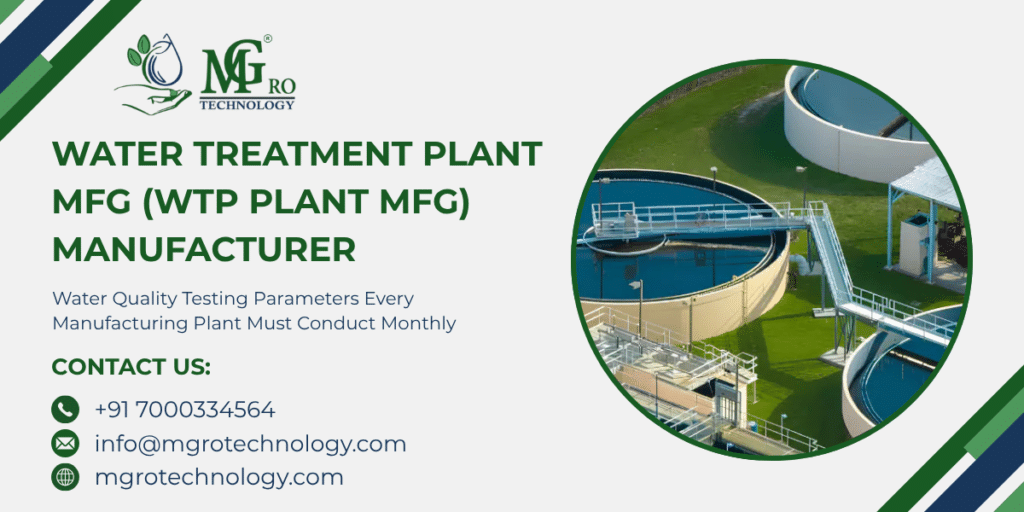
In heavy industrial manufacturing, chemical processing, pharmaceutical production, textile processing, and food processing facilities, water serves as a vital utility stream across steam generation, cooling circuits, process formulation, and equipment sanitation. The quality of incoming raw utility water varies continuously due to seasonal fluctuations, underground aquifer shifts, and municipal supply variations.
Maintaining strict process quality and operational continuity depends fundamentally on the monitoring systems engineered by a leading Water Treatment Plant MFG.
An industrial water analytical framework incorporates multi-parameter testing protocols, laboratory spectrophotometry, titrimetric evaluation, and online sensor arrays designed to monitor physical, chemical, and biological parameters.
Operating manufacturing facilities without conducting systematic monthly water quality testing leads to uncontrolled equipment corrosion, sudden mineral heat exchanger scaling, membrane surface bio-fouling, product contamination, and catastrophic boiler tube failures. Understanding the core theoretical mechanics governing hydrogen ion concentration, total dissolved solids, hardness ion balance, silica scaling potential, and microbiological proliferation enables plant engineers to implement proactive water quality management. This comprehensive technical guide provides an in-depth theoretical analysis of essential monthly water quality testing parameters for manufacturing facilities.
Theoretical Dynamics of Water Quality Analysis and Indicator Metrics
Evaluating water quality requires measuring key physical, chemical, and biological parameters to detect early signs of equipment fouling or chemical instability:
+-----------------------------------------------------------------+
|                   RAW INDUSTRIAL WATER SUPPLY                   |
| (Varies based on seasonal shifts, mineral dissolution, & source)|
+-----------------------------------------------------------------+
                                  |
                                  v
+-----------------------------------------------------------------+
|             MONTHLY PHYSICAL, CHEMICAL, & BIOLOGICAL ANALYSIS   |
| (Evaluates pH, TDS, Hardness, Silica, & Microbial metrics)      |
+-----------------------------------------------------------------+
                                  |
                                  v
+-----------------------------------------------------------------+
|             PREVENTIVE TREATMENT ADJUSTMENT & ASSET PROTECTION  |
| (Optimizes chemical dosing, membrane cleaning, & blowdown cycles)|
+-----------------------------------------------------------------+
1. Thermodynamic Equilibrium and Corrosivity Parameters
Theoretical Principle: Evaluating hydrogen ion activity and chemical equilibrium reveals whether water is corrosive or scale-forming. The balance between dissolved carbon dioxide, bicarbonate alkalinity, and calcium ions dictates fluid stability inside metallic piping and thermal heat exchangers.
Saturation Index Mechanics: Measuring pH, total alkalinity, and calcium hardness allows engineers to calculate theoretical saturation indices. A negative saturation value indicates aggressive, corrosive water that dissolves protective metal oxides, while a positive value indicates scaling conditions that deposit calcium carbonate onto heat transfer surfaces.
2. Dissolved Inorganic Salts and Scaling Potential
Theoretical Principle: Total Dissolved Solids measure the cumulative concentration of inorganic mineral cations and anions present in water. As process water evaporates in cooling towers or boilers, these dissolved minerals concentrate, exceeding their solubility thresholds.
Silica and Heavy Metal Risks: Reactive silica and heavy metals present severe scaling hazards. Reactive silica polymerizes into hard, glass-like silicate scales on high-temperature boiler tubes and high-pressure reverse osmosis membranes, creating insulating barriers that are extremely difficult to remove chemically.
Comprehensive Analysis of Core Monthly Testing Parameters
Implementing a robust monthly water quality monitoring program requires evaluating several critical analytical parameter groups:
Physical Parameters (Turbidity, Conductivity, and Silt Density Index): Measuring electrical conductivity provides a rapid estimate of total dissolved mineral content, while Silt Density Index testing quantifies colloidal particulate fouling tendencies that threaten membrane filtration elements.
Chemical Hardness Parameters (Calcium and Magnesium Concentrations): Total hardness testing evaluates the concentration of divalent metal cations. Tracking calcium and magnesium levels ensures ion-exchange softening beds are regenerating effectively before hard water reaches high-temperature equipment.
Oxidant and Disinfectant Residuals (Free Chlorine and Oxidation-Reduction Potential): Monitoring residual free chlorine downstream of carbon pre-filters prevents oxidative damage to sensitive polyamide reverse osmosis membranes while ensuring adequate disinfection in storage networks.
Microbiological Proliferation Metrics (Total Heterotrophic Plate Count): Assessing microbial populations prevents biofilm formation inside piping loops, storage reservoirs, and membrane channels, protecting product purity and preventing biological corrosion.
System Integration Across Industrial Water Treatment Infrastructure
Industrial water quality testing regimes protect equipment performance across integrated water purification networks:
Custom Plant Design & Manufacturing: Precision water systems engineered for specific raw water profiles are constructed by a expert Water Treatment Plant MFG.
High-Purity Membrane Protection: Testing data guides operating parameters for an Industrial RO Plant equipped with high-rejection Industrial RO Membrane elements, preventing fouling and scaling.
Hardness Removal System Monitoring: Monthly testing verifies performance across a high-capacity Water Softener Plant to prevent downstream hardness leakage.
Effluent Compliance & Recovery: Analytical monitoring supports process optimization within an Effluent Treatment Plant.
Sanitary Wastewater Purification: Testing ensures treated effluent meets reuse standards within a Sewage Treatment Plant.
Chilling Plant Scale Control: Monitoring cooling water chemistry prevents condenser tube fouling inside a heavy-duty Industrial Water Chiller.
Theoretical Best Practices for Monthly Water Quality Testing
To maintain high analytical accuracy and protect industrial utility infrastructure, plant engineers follow three core theoretical guidelines:
Establish Baseline Profile Datasets for Raw Water Sources: Maintain historical water quality trend logs across seasonal cycles to anticipate sudden shifts in raw water turbidity, mineral hardness, or organic loading.
Standardize Laboratory Sampling Procedures and Hold Times: Collect water samples in sterile, non-reactive containers, preserving samples under controlled thermal conditions to prevent chemical precipitation or bacterial growth prior to analysis.
Cross-Calibrate Online Instruments with Laboratory Titrations: Regularly calibrate continuous inline conductivity, pH, and turbidity sensors against standardized benchtop laboratory titrations to ensure continuous instrument measurement accuracy.
Conclusion
Understanding the theoretical mechanics of monthly water quality testing parameters is essential for protecting industrial processing equipment and maintaining operational efficiency. By systematically evaluating pH stability, total dissolved solids, mineral hardness, reactive silica, residual oxidants, and microbiological counts, manufacturing facilities prevent costly equipment failures, optimize chemical dosing schedules, and guarantee continuous high-purity water generation.
Looking for Precision Industrial Water Treatment and Analytical Solutions? Explore our complete range of custom engineering from a leading Water Treatment Plant MFG, high-efficiency Industrial RO Plant and Industrial RO Membrane setups, heavy-duty Water Softener Plant units, industrial Effluent Treatment Plant and Sewage Treatment Plant installations, and precise Industrial Water Chiller systems at MGRO Technology. Contact our expert engineering team today.
 Users Today : 9
 Users This Month : 673
 Total Users : 717