
In food and beverage processing, dairy chilling, brewery fermentation, pharmaceutical reaction synthesis, and low-temperature chemical production, fluid temperatures must frequently drop near or below the freezing point of water. Operating industrial refrigeration systems at sub-zero or near-zero supply temperatures requires specialized fluid chemistry to maintain continuous liquid circulation without ice crystal formation.
Achieving reliable sub-zero thermal transfer depends fundamentally on fluid chemistry management within an engineered Industrial Water Chiller.
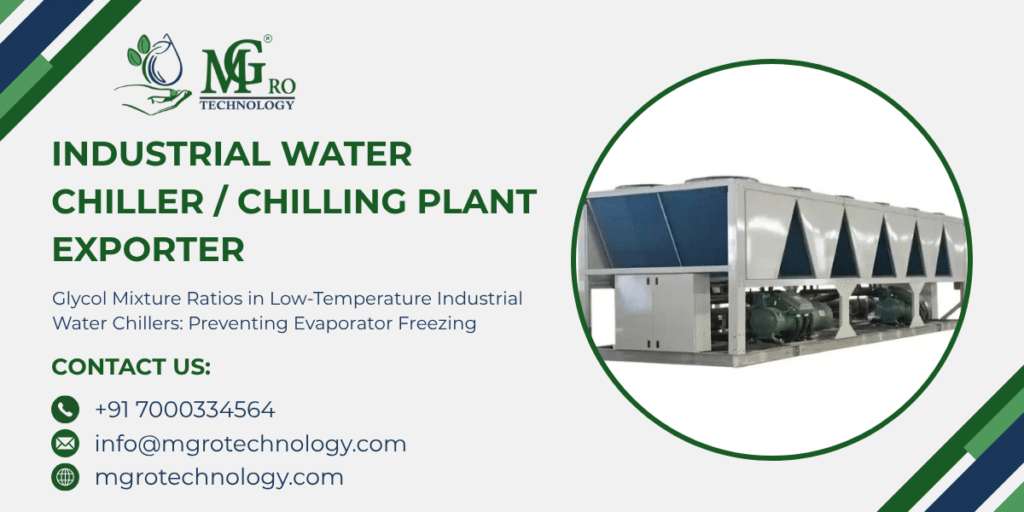
An industrial chilling plant processing low-temperature secondary coolants incorporates high-efficiency compressors, brazed plate or shell-and-tube evaporators, thermal expansion valves, and heavy-duty fluid circulation pumps designed to handle viscous fluids.
Operating low-temperature chillers using pure water or inadequate glycol concentrations leads to catastrophic evaporator tube freezing, structural heat exchanger rupture, refrigerant contamination, pump cavitation, and complete plant failure. Understanding the core theoretical thermodynamic principles governing freezing point depression, freeze protection versus burst protection thresholds, viscosity increases, and heat transfer penalty tradeoffs enables facility engineers to formulate optimal glycol concentration ratios. This comprehensive technical guide provides an in-depth theoretical analysis of glycol mixture ratios in low-temperature industrial water chillers.
Theoretical Dynamics of Freezing Point Depression and Thermodynamics
Preventing ice crystal nucleation inside heat exchanger channels requires altering the physical phase-change properties of the circulating liquid medium:
+-----------------------------------------------------------------+
|                   COOLANT FLUID MOLECULAR SOLUTION              |
| (Water molecules form strong hydrogen bonds prone to freezing)  |
+-----------------------------------------------------------------+
                                  |
                                  v
+-----------------------------------------------------------------+
|             GLYCOL ADDITION & MOLECULAR INTERFERENCE            |
| (Inhibitor molecules disrupt ice crystal lattice formation)     |
+-----------------------------------------------------------------+
                                  |
                                  v
+-----------------------------------------------------------------+
|             FREEZING POINT DEPRESSION & LIQUID STATE PHASES      |
| (Coolant remains liquid at sub-zero evaporator temperatures)    |
+-----------------------------------------------------------------+
1. Colligative Properties and Freezing Point Depression
Theoretical Principle: Freezing point depression is a colligative property of aqueous solutions. Adding a non-volatile solute, such as ethylene glycol or propylene glycol, to water disrupts the hydrogen bonding network necessary for water molecules to align into a rigid crystalline ice lattice.
Crystalline Lattice Suppression: As glycol concentration increases, the temperature required to initiate ice crystallization drops significantly. This molecular disruption allows the secondary coolant to remain in a fully fluid, pumpable state at operating temperatures well below the normal freezing point of pure water.
2. Freeze Protection vs. Burst Protection Mechanisms
Theoretical Principle: Fluid thermodynamics distinguishes between two levels of thermal protection: freeze protection and burst protection. Freeze protection maintains the glycol solution in a fully liquid state, preventing any ice crystal formation at lowest expected operating temperatures.
Slurry Phase Behavior: Burst protection utilizes a lower glycol concentration designed to allow the fluid to freeze into a soft, slushy slurry without undergoing volumetric expansion. While burst protection prevents physical piping rupture during standby shutdowns, active chiller operation requires true freeze protection to prevent evaporator flow blockage.
Comprehensive Analysis of Ethylene vs. Propylene Glycol Mechanics
Selecting and formulating the correct glycol type requires balancing toxicity standards against fluid thermodynamic performance:
Ethylene Glycol Thermal Efficiency: Ethylene glycol features lower fluid viscosity and superior heat transfer performance across sub-zero temperature ranges. It is the industry standard for closed-loop industrial applications where fluid toxicity is not a factor.
Propylene Glycol Food-Grade Safety: Propylene glycol is classified as non-toxic and environmentally safe, making it mandatory for food, beverage, dairy, and pharmaceutical applications where accidental contact with consumable products could occur.
Viscosity Penalties and Pump Energy Losses: Increasing glycol concentration significantly raises fluid viscosity, particularly at low operating temperatures. Elevated viscosity increases hydraulic friction inside piping, requiring higher pumping horsepower and reducing fluid flow velocity.
Heat Transfer Coefficient Degradation: Glycol has a lower specific heat capacity and lower thermal conductivity than pure water. Higher glycol concentration ratios reduce the overall heat transfer coefficient inside the evaporator, requiring larger surface area heat exchangers.
System Integration Across Industrial Water Treatment Infrastructure
Industrial water chillers operate as vital thermal regulation systems within integrated industrial facilities:
Process Thermal Regulation: Low-temperature precision cooling for chemical reactors and food processing is maintained using a heavy-duty Industrial Water Chiller.
Primary Hardness & Scale Protection: Makeup water used to formulate glycol solutions is pre-treated using a high-capacity Water Softener Plant to prevent mineral salt precipitation.
High-Purity Makeup Water Supply: High-purity, low-TDS water for glycol diluent is produced using an advanced Industrial RO Plant fitted with high-rejection Industrial RO Membrane elements.
Wastewater & Effluent Cooling: Industrial wastewater streams are cooled prior to biological treatment or discharge using an engineered Effluent Treatment Plant.
Sanitary Sewage Purification: Facility sanitary wastewater is processed using a specialized Sewage Treatment Plant.
Comprehensive Turnkey Manufacturing: Plant engineering, skid fabrication, and chilling system integration are delivered by a trusted Water Treatment Plant MFG.
Theoretical Best Practices for Low-Temperature Chiller Operation
To prevent evaporator freezing, eliminate fluid degradation, and optimize low-temperature chilling operations, design engineers follow three core theoretical guidelines:
Maintain Freeze Protection Margins Below Operating Setpoint: Formulate glycol concentration to ensure the solution freezing point remains comfortably below the lowest expected saturated evaporator suction temperature, rather than just the fluid supply temperature.
Utilize Deionized or Reverse Osmosis Water for Dilution: Always mix glycol concentrates with purified reverse osmosis water to prevent calcium scaling and chloride-induced corrosion inside copper or stainless steel evaporator tubes.
Incorporate Inhibited Glycol Formulations and Monitor pH: Use industrial glycol formulations containing corrosion inhibitors and buffering agents, checking fluid pH and refractometer freeze points regularly to detect chemical thermal degradation.
Conclusion
Understanding the theoretical dynamics of freezing point depression, fluid viscosity trade-offs, and thermal heat transfer degradation is essential for managing glycol mixture ratios in low-temperature industrial water chillers. By formulating precise glycol concentrations, selecting appropriate fluid chemistries, and maintaining freeze protection safety margins, industrial facilities eliminate evaporator freeze risks, protect chilling plant infrastructure, and maintain stable sub-zero cooling.
Looking for Precision Industrial Chilling and Water Treatment Solutions? Explore our complete range of high-efficiency Industrial Water Chiller units, heavy-duty Water Softener Plant installations, advanced Industrial RO Plant and Industrial RO Membrane systems, industrial Effluent Treatment Plant and Sewage Treatment Plant setups, and custom engineering from a leading Water Treatment Plant MFG at MGRO Technology. Contact our expert engineering team today.
 Users Today : 1
 Users This Month : 665
 Total Users : 709