
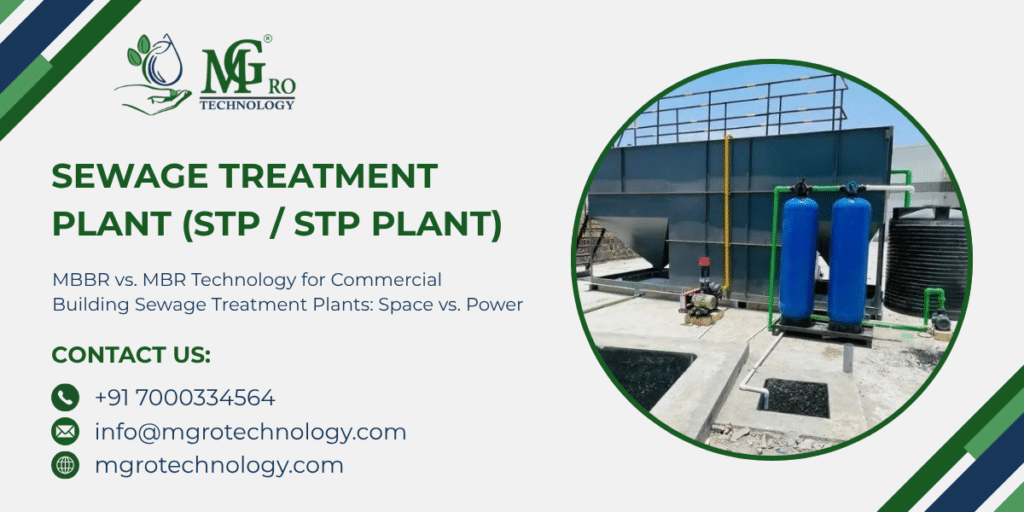
In modern commercial real estate, high-rise corporate towers, shopping malls, hospitality complexes, and residential townships, effective onsite domestic wastewater treatment is essential. Commercial establishments generate continuous volumes of sanitary sewage containing organic waste, suspended solids, nitrogen compounds, and household detergents that must be purified for non-potable reuse or safe environmental discharge.
Achieving efficient biological purification and space optimization depends fundamentally on the technology selected for a Sewage Treatment Plant (STP Plant).
A commercial sewage treatment plant incorporates coarse screening, equalization basins, biological reactors, secondary clarification or membrane filtration units, and disinfection systems engineered to process sanitary wastewater streams.
Selecting an inappropriate biological architecture for commercial building STPs leads to excessive real estate footprint consumption, soaring electrical power bills, frequent membrane fouling, operational noise pollution, and secondary discharge non-compliance. Understanding the core theoretical differences governing Moving Bed Biofilm Reactors (MBBR) and Membrane Bioreactors (MBR) enables building design consultants to balance spatial constraints against long-term energy consumption. This comprehensive technical guide provides an in-depth theoretical analysis comparing MBBR and MBR technologies for commercial building sewage treatment plants.
Theoretical Dynamics of Biofilm Carriers and Membrane Separation
Commercial sewage treatment relies on advanced biological oxidation, utilizing either attached-growth biofilm media or submerged membrane filtration barriers:
+-----------------------------------------------------------------+
|                   RAW COMMERCIAL SANITARY SEWAGE                |
| (High peak flows, variable organic loading, & suspended solids) |
+-----------------------------------------------------------------+
                                  |
                                  v
+-----------------------------------------------------------------+
|             BIOLOGICAL REACTOR METABOLIC OXIDATION              |
| (MBBR attached-growth biofilm OR MBR suspended-growth biomass)  |
+-----------------------------------------------------------------+
                                  |
                                  v
+-----------------------------------------------------------------+
|             SOLID-LIQUID SEPARATION & EFFLUENT POLISHING        |
| (MBBR settling clarifier vs MBR direct ultrafiltration barrier) |
+-----------------------------------------------------------------+
1. Moving Bed Biofilm Reactor (MBBR) Protected Biofilm Kinetics
Theoretical Principle: MBBR technology utilizes high-surface-area polyethylene carrier elements suspended in continuous motion within the aeration tank. Microorganisms form a dense, protected biological film inside the protected spaces of these moving carriers.
Hydraulic and Load Flexibility: Attached-growth MBBR systems resist hydraulic shock loads and organic fluctuations common in commercial buildings. Because biomass remains fixed to moving media, downstream solid-liquid separation requires a conventional secondary clarifier or tube settler.
2. Membrane Bioreactor (MBR) Ultrafiltration Barrier Kinetics
Theoretical Principle: MBR technology combines suspended-growth activated sludge biological treatment with submerged microfiltration or ultrafiltration membrane separation. The physical membrane barrier replaces traditional gravity secondary clarifiers entirely.
Complete Solids Retention: By physically straining out suspended solids and bacterial flocs through microscopic pore channels, MBR systems maintain extremely high biomass concentrations inside the reactor, delivering near-crystal-clear effluent quality.
In-Depth Analysis of Space Footprint vs. Power Consumption
Evaluating the theoretical and operational trade-offs between MBBR and MBR architectures highlights critical design considerations for commercial buildings:
Spatial Footprint and Real Estate Utilization: MBR systems offer unmatched footprint compactness. Operating at ultra-high biomass levels and eliminating secondary clarifiers reduces total plant footprint significantly, making MBR ideal for tight basement installations.
Electrical Power Consumption Dynamics: MBBR systems require lower operational energy, relying primarily on standard blowers for aeration and media mixing. Conversely, MBR systems require high continuous aeration energy to scour membrane surfaces and prevent physical fouling, resulting in higher power consumption.
Effluent Quality and Reuse Suitability: MBR delivers superior, highly disinfected permeate water suitable for direct high-grade flushing and cooling tower make-up. MBBR effluent requires downstream tertiary sand filters, carbon beds, and disinfection units to achieve comparable purity.
Operational Maintenance Complexity: MBBR systems feature simple operational mechanics with minimal mechanical interventions. MBR architectures require periodic chemical Clean-in-Place cycles, transmembrane pressure monitoring, and eventual membrane module replacements.
System Integration Across Industrial Water Treatment Infrastructure
Sewage treatment plants operate as central environmental protection systems within integrated commercial and industrial facilities:
Commercial & Domestic Wastewater Purification: Sanitary wastewater purification and non-potable recycling are executed through a specialized Sewage Treatment Plant.
Industrial Wastewater Remediation: Heavy industrial liquid waste processing and organic pollutant reduction are handled via an engineered Effluent Treatment Plant.
Hardness Removal & Scale Prevention: Utility water supplies are softened using a high-capacity Water Softener Plant to protect building plumbing networks.
High-Purity Water Generation: Low-TDS process feed water is produced using an advanced Industrial RO Plant fitted with high-rejection Industrial RO Membrane elements.
HVAC Thermal Regulation: Cooling tower loops and HVAC operating temperatures are maintained across commercial buildings using a heavy-duty Industrial Water Chiller.
Comprehensive Turnkey Manufacturing: Plant engineering, skid fabrication, and biological reactor integration are delivered by a trusted Water Treatment Plant MFG.
Theoretical Best Practices for Commercial STP Selection
To optimize equipment capital costs, footprint limitations, and operational power expenses in commercial buildings, design consultants follow three core theoretical guidelines:
Prioritize MBBR for Lower Operational Power Budgets: Specify MBBR technology when commercial building operators seek low daily energy consumption, simple maintenance routines, and adequate baseline effluent quality.
Select MBR for Extreme Space Restrictions and High-Purity Reuse: Utilize MBR systems when basement installation space is severely restricted and recycled water must meet stringent non-potable reuse standards.
Incorporate Robust Pre-Screening Protection: Install fine bar screens upstream of both technologies to protect MBBR carrier media from escaping and prevent coarse debris from damaging MBR membrane fibers.
Conclusion
Understanding the theoretical trade-offs between MBBR and MBR technologies is essential for selecting the ideal commercial building sewage treatment plant. By evaluating real estate spatial constraints, electrical power consumption budgets, maintenance capabilities, and target water reuse standards, building designers create efficient, reliable STP systems that ensure continuous environmental compliance.
Looking for Premium Commercial Sewage and Industrial Water Treatment Solutions? Explore our complete range of high-efficiency Sewage Treatment Plant installations, advanced Effluent Treatment Plant setups, heavy-duty Water Softener Plant units, industrial Industrial RO Plant and Industrial RO Membrane systems, precise Industrial Water Chiller units, and custom engineering from a leading Water Treatment Plant MFG at MGRO Technology. Contact our expert engineering team today.
 Users Today : 6
 Users This Month : 726
 Total Users : 770