
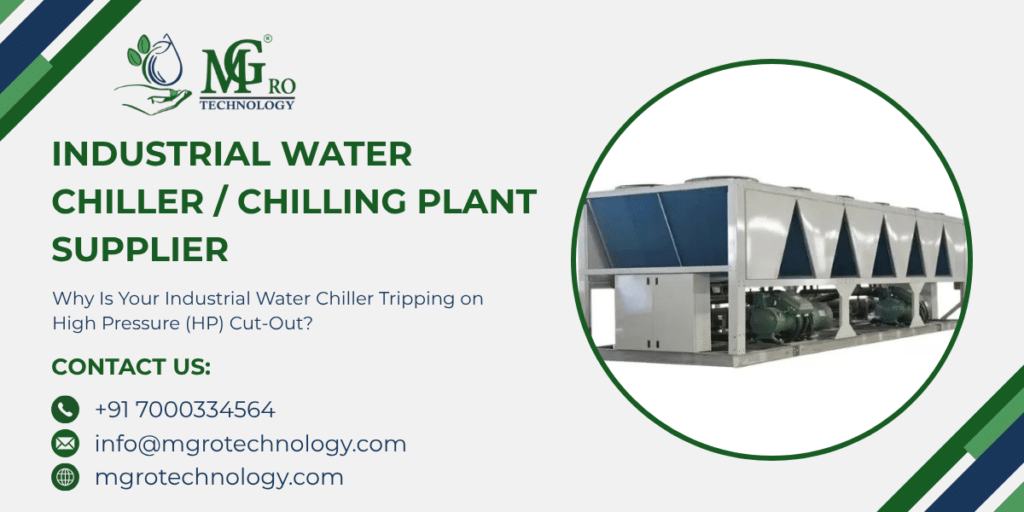
In pharmaceutical manufacturing, plastics extrusion, chemical processing, laser machining, and food production plants, continuous thermal regulation is critical to operational continuity. Industrial chillers rely on a stable, closed-loop vapor-compression refrigeration cycle to absorb process heat and reject it into the environment.
Maintaining smooth refrigeration cycles and preventing safety shutdowns depends fundamentally on the operational health of an engineered Industrial Water Chiller.
An industrial chilling plant incorporates high-efficiency scroll, screw, or reciprocating compressors, shell-and-tube or brazed plate evaporators, air- or water-cooled condensers, thermal expansion valves, and safety pressure switches designed to protect equipment from mechanical damage.
Experiencing frequent High Pressure (HP) cut-out trips leads to sudden production line stoppages, product batch spoilage, thermal shock to manufacturing equipment, excessive electrical peak surges, and catastrophic compressor motor failure. Understanding the core theoretical thermodynamic mechanisms governing high condensing temperatures, non-condensable gas accumulation, condenser tube scaling, and refrigerant overcharging enables plant engineers to diagnose and resolve pressure faults effectively. This comprehensive technical guide provides an in-depth theoretical analysis of why industrial water chillers trip on high pressure cut-out switches.
Theoretical Dynamics of High Discharge Pressure and Safety Cut-Outs
The High Pressure (HP) safety cut-out switch is a critical mechanical protection device designed to interrupt power to the compressor when discharge line pressure exceeds safe design thresholds:
+-----------------------------------------------------------------+
|                   REFRIGERANT VAPOR COMPRESSION                 |
| (Compressor discharges high-temperature, high-pressure gas)     |
+-----------------------------------------------------------------+
                                  |
                                  v
+-----------------------------------------------------------------+
|               CONDENSER HEAT TRANSFER BARRIER OR BLOCKAGE       |
| (Scale buildup, fan failure, or air blockage impedes cooling)   |
+-----------------------------------------------------------------+
                                  |
                                  v
+-----------------------------------------------------------------+
|             PRESSURE SURGE & HIGH-PRESSURE (HP) CUT-OUT TRIP    |
| (Refrigerant gas fails to condense; discharge pressure spikes)  |
+-----------------------------------------------------------------+
1. Thermodynamic Condensing Saturation Mechanics
Theoretical Principle: Within the refrigeration cycle, compressor discharge pressure is directly proportional to the condensing temperature of the refrigerant. For refrigerant gas to convert back into a liquid, the condenser must efficiently transfer latent thermal heat out of the system.
Pressure Surge Trigger: If heat exchange efficiency drops in the condenser, refrigerant gas cannot condense into liquid fast enough. The accumulation of uncondensed hot gas inside the high-pressure side of the circuit causes saturated discharge pressure to rise exponentially, triggering the safety HP cut-out switch to prevent structural rupture.
2. Heat Rejection Resistance and Sub-Cooling Degradation
Theoretical Principle: Effective heat rejection requires an unimpeded thermal boundary layer between hot refrigerant tubes and the cooling medium (air or water). When physical barriers or fluid flow restrictions increase thermal resistance across the condenser, the temperature gradient collapses.
Sub-Cooling Loss: Elevated condensing temperatures reduce liquid sub-cooling at the expansion valve inlet. This thermodynamic inefficiency forces the compressor to pump hotter, higher-density vapor at elevated head pressures, quickly exceeding safety setpoint limits.
In-Depth Analysis of Root Causes for HP Cut-Out Trips
Diagnosing high pressure cut-out trips requires evaluating both external fluid loop conditions and internal refrigeration circuit parameters:
Inadequate Condenser Airflow or Ambient Heat Stagnation: In air-cooled chillers, clogged aluminum fins, failed axial condenser fans, or recirculation of hot exhaust air severely restricts heat dissipation, driving up head pressure.
Fouling and Mineral Scaling inside Condenser Tubes: In water-cooled chillers, hard water mineral deposits, algae growth, or mud accumulation inside shell-and-tube condensers create an insulating thermal barrier that prevents heat transfer to cooling tower water.
Non-Condensable Gas Contamination in Refrigerant Loop: Air or moisture introduced during improper servicing acts as a non-condensable gas inside the circuit. These gases collect in the top of the condenser, reducing active heat transfer area and boosting total system pressure.
Overcharging of Refrigerant Charge: Excess refrigerant liquid fills the lower tubes of the condenser, physically reducing the surface area available for gas condensation and causing rapid high-pressure spikes under heavy thermal loads.
Cooling Tower Water Flow Failure: Restricted cooling tower pumps, closed condenser isolation valves, or high inlet cooling water temperatures deprive water-cooled chillers of sufficient heat sink capacity.
System Integration Across Industrial Water Treatment Infrastructure
Industrial water chillers operate as vital thermal regulation systems within integrated industrial facilities:
Process Thermal Regulation: Precision cooling for industrial machinery and chemical reactors is maintained using a heavy-duty Industrial Water Chiller.
Primary Hardness & Scale Protection: Cooling tower makeup water for water-cooled chillers is softened using a high-capacity Water Softener Plant to prevent scale formation inside condenser tubes.
High-Purity Water Supply: Ultra-pure process cooling water is generated using an advanced Industrial RO Plant fitted with high-rejection Industrial RO Membrane elements.
Wastewater & Effluent Cooling: Industrial wastewater streams are cooled prior to biological treatment or discharged using an engineered Effluent Treatment Plant.
Sanitary Sewage Purification: Facility sanitary wastewater is processed using a specialized Sewage Treatment Plant.
Comprehensive Turnkey Manufacturing: Plant engineering, skid fabrication, and chilling system integration are delivered by a trusted Water Treatment Plant MFG.
Theoretical Best Practices to Prevent High Pressure Trips
To eliminate unexpected HP cut-out trips and maintain reliable chiller operation, design engineers follow three core theoretical guidelines:
Enforce Strict Water Softening for Condenser Makeup: Pre-treat all cooling tower makeup water through an ion-exchange softening system to prevent mineral scale deposition inside condenser heat exchanger tubes.
Maintain Unobstructed Condenser Airflow Pathways: Position air-cooled chillers in open outdoor spaces with generous clearance margins to eliminate hot air short-circuiting and maintain low ambient intake temperatures.
Execute Rigorous System Evacuation During Servicing: Utilize high-vacuum evacuation procedures whenever servicing refrigeration circuits to ensure all non-condensable air and moisture are removed before recharging.
Conclusion
Understanding the theoretical causes of High Pressure (HP) cut-out trips is essential for maintaining continuous, reliable operation of industrial water chillers. By controlling condenser fouling, ensuring adequate airflow and cooling water circulation, preventing refrigerant overcharging, and eliminating non-condensable contamination, facility engineers protect compressor assets, prevent costly production downtime, and maximize energy efficiency.
Looking for Precision Industrial Chilling and Water Treatment Solutions? Explore our complete range of high-efficiency Industrial Water Chiller units, heavy-duty Water Softener Plant installations, advanced Industrial RO Plant and Industrial RO Membrane systems, industrial Effluent Treatment Plant and Sewage Treatment Plant setups, and custom engineering from a leading Water Treatment Plant MFG at MGRO Technology. Contact our expert engineering team today.
 Users Today : 10
 Users This Month : 674
 Total Users : 718