
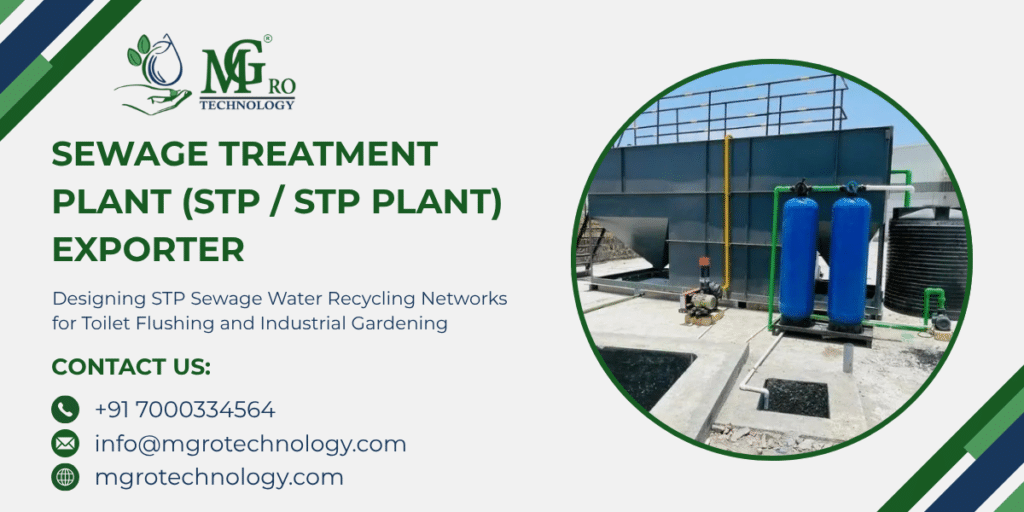
In sustainable commercial real estate, corporate parks, residential townships, urban industrial estates, and green building projects, onsite water conservation is a top priority. Commercial complexes consume vast quantities of fresh municipal water daily for non-potable applications such as toilet flushing, landscape irrigation, dust suppression, and HVAC cooling tower make-up water.
Achieving complete water circularity and reducing freshwater demand relies on the advanced recycling loops of a Sewage Treatment Plant (STP Plant).
A recycled water distribution system incorporates secondary biological treatment units, tertiary sand and carbon filtration media, advanced disinfection reactors, dual-pipe network distribution lines, and dedicated storage reservoirs engineered to supply high-quality reclaimed water.
Designing non-potable recycling networks without understanding the theoretical parameters governing pathogen inactivation, bio-film growth in dual piping, residual chlorination stability, and nutrient polishing leads to severe distribution line bio-fouling, foul aesthetic odors, health hazards, pipe cross-contamination, and pump corrosion. Understanding the core theoretical mechanics governing tertiary polishing, ozone oxidation, residual disinfection, and hydraulic pressure separation enables civil and environmental engineers to design safe sewage water recycling networks. This comprehensive technical guide provides an in-depth theoretical analysis of designing STP sewage water recycling networks for toilet flushing and industrial gardening.
Theoretical Kinetics of Tertiary Treatment and Non-Potable Water Polishing
Transforming secondary biological effluent into safe, clear, odor-free reclaimed water requires multi-barrier physical and chemical purification processes:
+-----------------------------------------------------------------+
|                   SECONDARY BIOLOGICAL STP EFFLUENT             |
| (Contains low residual organics, micro-solids, & pathogens)     |
+-----------------------------------------------------------------+
                                  |
                                  v
+-----------------------------------------------------------------+
|             TERTIARY MULTI-MEDIA FILTRATION & ADSORPTION        |
| (Pressure sand filters & activated carbon trap fines & odors)   |
+-----------------------------------------------------------------+
                                  |
                                  v
+-----------------------------------------------------------------+
|             ADVANCED OXIDATION DISINFECTION & DUAL PIPING       |
| (UV/Chlorine destroys pathogens; recycled water pumped to reuse)|
+-----------------------------------------------------------------+
1. Tertiary Physical Filtration and Organic Adsorption Kinetics
Theoretical Principle: Secondary biological effluent contains trace suspended micro-solids, colloidal turbidity, and residual dissolved organic molecules. Passing secondary effluent through multi-media pressure sand filters mechanically traps fine suspended particulates across graded garnet and quartz sand beds.
Adsorption of Color and Odor: Subsequent granular activated carbon filtration relies on surface adsorption mechanics to remove trace organic compounds, synthetic detergents, and residual color molecules, restoring high aesthetic clarity to the reclaimed water stream.
2. Multi-Barrier Pathogen Disinfection and Residual Stability
Theoretical Principle: Non-potable reuse in public spaces demands complete pathogen inactivation, targeting enteric viruses, fecal coliform bacteria, and parasite cysts. Combining primary ultraviolet irradiation with secondary chemical chlorination provides a multi-barrier disinfection mechanism.
Residual Protection in Distribution: Ultraviolet light damages pathogen cellular DNA, rendering microbes non-viable without creating chemical byproducts. Subsequent chlorine dosing provides long-lasting residual disinfection throughout long distribution pipes, preventing bio-film regrowth on pipe walls.
In-Depth Analysis of Dual-Pipe Network Design Parameters
Designing safe dual-pipe recycling networks for commercial and industrial facilities requires implementing core engineering separation principles:
Hydraulic Isolation and Cross-Contamination Prevention: Recycled water networks must remain completely separate from potable fresh water piping. Maintaining physical air gaps, reduced-pressure zone backflow preventers, and distinct color-coded purple piping prevents accidental cross-connection.
Biological Nutrient Polishing for Landscape Irrigation: High levels of residual nitrogen and phosphorus in recycled water can cause soil salinity build-up and leaf burn in sensitive plants. Tertiary biological polishing stabilizes nutrient levels, converting ammonia to nitrate for safe botanical absorption.
Corrosion Control and Residual Chlorine Stability: Recycled water containing elevated dissolved salts and residual oxidants can corrode metallic pipes and flushing fixtures. Utilizing non-corrosive high-density polyethylene or PVC piping ensures long-term structural network integrity.
Variable Hydro-Pneumatic Pumping Mechanics: Toilet flushing applications exhibit extreme peak demand patterns during morning and evening hours. Incorporating variable-frequency hydro-pneumatic booster pumping systems maintains stable distribution line pressure across high-rise building risers.
System Integration Across Industrial Water Treatment Infrastructure
Sewage treatment plants operate as central environmental protection systems within integrated commercial and industrial facilities:
Commercial & Domestic Wastewater Purification: Sanitary wastewater purification and non-potable recycling are executed through a specialized Sewage Treatment Plant.
Industrial Wastewater Remediation: Heavy industrial liquid waste processing and organic pollutant reduction are handled via an engineered Effluent Treatment Plant.
Hardness Removal & Scale Prevention: Utility water supplies are softened using a high-capacity Water Softener Plant to protect building plumbing networks.
High-Purity Water Generation: Low-TDS process feed water is produced using an advanced Industrial RO Plant fitted with high-rejection Industrial RO Membrane elements.
HVAC Thermal Regulation: Cooling tower loops and HVAC operating temperatures are maintained across commercial buildings using a heavy-duty Industrial Water Chiller.
Comprehensive Turnkey Manufacturing: Plant engineering, skid fabrication, and biological reactor integration are delivered by a trusted Water Treatment Plant MFG.
Theoretical Best Practices for Water Recycling Networks
To ensure safe operation, high water aesthetic quality, and regulatory compliance across non-potable recycling networks, design consultants follow three core theoretical guidelines:
Enforce Strict Dual-Pipe Color-Coding and Labeling: Mandate distinct purple pipe markings, specialized valve tags, and non-potable warnings along all recycled water distribution networks to eliminate accidental cross-connections.
Maintain Continuous Chlorine Residual in Storage Reservoirs: Monitor free chlorine residual levels continuously inside recycled water storage tanks, automatically dosing sodium hypochlorite to maintain microbial control during long holding periods.
Incorporate Automatic Turbidity Bypass Valves: Install inline turbidimeters downstream of tertiary filters with automated three-way divert valves to automatically bypass off-spec water back to equalization tanks if filtration efficiency drops.
Conclusion
Understanding the theoretical principles of tertiary filtration, multi-barrier disinfection, and dual-pipe hydraulic design is essential for constructing safe, reliable sewage water recycling networks. By polishing secondary biological effluent, removing pathogens, isolating non-potable piping, and maintaining distribution system residuals, commercial and industrial facilities achieve maximum water conservation, lower utility expenditures, and support environmental sustainability.
Looking for Premium Commercial Sewage and Industrial Water Treatment Solutions? Explore our complete range of high-efficiency Sewage Treatment Plant installations, advanced Effluent Treatment Plant setups, heavy-duty Water Softener Plant units, industrial Industrial RO Plant and Industrial RO Membrane systems, precise Industrial Water Chiller units, and custom engineering from a leading Water Treatment Plant MFG at MGRO Technology. Contact our expert engineering team today.
 Users Today : 10
 Users This Month : 730
 Total Users : 774