
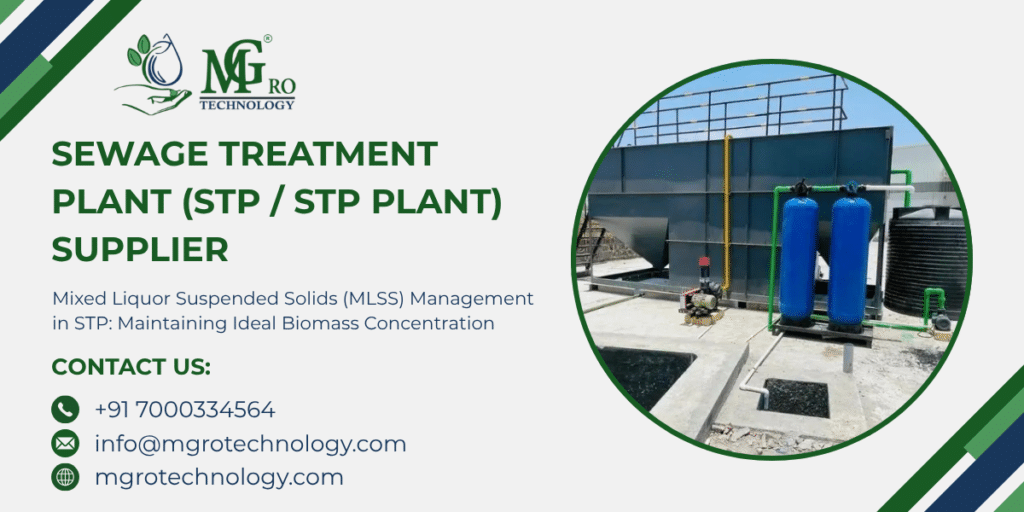
In commercial real estate complexes, municipal wastewater facilities, industrial townships, and institutional campuses, maintaining biological reactor stability is vital for effective sewage purification. Secondary biological treatment relies on maintaining an active population of heterotrophic microorganisms suspended within aeration basins to digest organic impurities.
Sustaining consistent organic pollutant removal depends fundamentally on managing biomass inventory inside a Sewage Treatment Plant (STP Plant).
A commercial sewage treatment plant incorporates biological aeration basins, fine-bubble oxygen diffusers, secondary settling clarifiers, return activated sludge pumps, and waste activated sludge discharge systems designed to balance microbial growth.
Operating biological aeration tanks without controlling Mixed Liquor Suspended Solids (MLSS) inventory leads to severe organic treatment failure, oxygen transfer starvation, excessive sludge carryover in clarifiers, rapid sludge bulking, and regulatory effluent violations. Understanding the core theoretical mechanisms governing food-to-microorganism balance, mean cell residence time, endogenous respiration, and solids settling velocity enables plant engineers to maintain optimal biomass concentrations. This comprehensive technical guide provides an in-depth theoretical analysis of MLSS management in sewage treatment plants.
Theoretical Dynamics of Biomass Kinetics and F/M Ratio
Biological waste degradation occurs through metabolic consumption, where microorganisms convert dissolved organic carbon into carbon dioxide, water, and new cellular mass:
+-----------------------------------------------------------------+
|                   INCOMING SANITARY ORGANIC LOAD                |
| (Substrate enters aeration tank containing dissolved carbon)    |
+-----------------------------------------------------------------+
                                  |
                                  v
+-----------------------------------------------------------------+
|             BIOMASS METABOLISM & CELL SYNTHESIS                 |
| (Microorganisms consume substrate, generating new MLSS mass)    |
+-----------------------------------------------------------------+
                                  |
                                  v
+-----------------------------------------------------------------+
|             CONTROLLED SLUDGE WASTAGE & RECYCLING               |
| (RAS returns active biomass; WAS controls total MLSS inventory)|
+-----------------------------------------------------------------+
1. Food-to-Microorganism (F/M) Equilibrium Mechanics
Theoretical Principle: The Food-to-Microorganism ratio defines the relationship between incoming organic substrate loading and the active microbial mass available in the aeration basin. Maintaining an optimal equilibrium ensures that sufficient microorganisms are present to consume incoming organic pollutants completely.
Over-Loading vs. Starvation: An excessively high F/M ratio (low MLSS) overloads the available biomass, resulting in incomplete organic degradation and cloudy effluent. Conversely, an excessively low F/M ratio (high MLSS) starves the microbial population, causing cell autolysis, pin-floc formation, and poor settling performance.
2. Mean Cell Residence Time and Sludge Wastage Kinetics
Theoretical Principle: Mean Cell Residence Time, or sludge age, represents the average theoretical duration active bacterial cells remain inside the biological reactor system. Sludge age directly dictates the dominant microbial species and their metabolic digestion rates.
Inventory Control via Waste Activated Sludge: Because microorganisms reproduce continuously while consuming organic waste, total MLSS mass increases steadily. Regulating biomass inventory requires systematic waste activated sludge extraction from the system to maintain target sludge age and steady-state MLSS levels.
Comprehensive Analysis of MLSS Operational Parameters
Managing Mixed Liquor Suspended Solids concentration involves balancing several core operational parameters within the biological loop:
Return Activated Sludge (RAS) Recirculation Kinetics: Recirculating settled biomass from the secondary clarifier back into the aeration tank header preserves continuous active microbial concentrations, preventing biomass depletion inside the reactor.
Oxygen Transfer Efficiency and Aeration Energy: High MLSS concentrations increase fluid viscosity in the aeration basin. Higher solids levels require greater aeration energy to maintain dissolved oxygen levels and ensure uniform mixing across the tank volume.
Secondary Clarifier Hydraulic and Solids Loading: Clarifiers are limited by both hydraulic surface overflow rates and total solids loading rates. Maintaining excessively high MLSS levels overburdens secondary clarifiers, causing sludge blanket rise and solids carryover.
Endogenous Respiration and Sludge Yield Mechanics: At extended sludge ages, microorganisms enter endogenous respiration, consuming their own cellular mass for energy. This reduces net sludge production yields but increases oxygen consumption requirements.
System Integration Across Industrial Water Treatment Infrastructure
Sewage treatment plants operate as central environmental protection systems within integrated commercial and industrial facilities:
Commercial & Domestic Wastewater Purification: Sanitary wastewater purification and non-potable recycling are executed through a specialized Sewage Treatment Plant.
Industrial Wastewater Remediation: Heavy industrial liquid waste processing and organic pollutant reduction are handled via an engineered Effluent Treatment Plant.
Hardness Removal & Scale Prevention: Utility water supplies are softened using a high-capacity Water Softener Plant to protect building plumbing networks.
High-Purity Water Generation: Low-TDS process feed water is produced using an advanced Industrial RO Plant fitted with high-rejection Industrial RO Membrane elements.
HVAC Thermal Regulation: Cooling tower loops and HVAC operating temperatures are maintained across commercial buildings using a heavy-duty Industrial Water Chiller.
Comprehensive Turnkey Manufacturing: Plant engineering, skid fabrication, and biological reactor integration are delivered by a trusted Water Treatment Plant MFG.
Theoretical Best Practices for MLSS Inventory Control
To optimize organic removal efficiency and maintain biological stability in sewage treatment plants, design engineers follow three core theoretical guidelines:
Adjust MLSS Targets Based on Seasonal Temperature: Maintain higher MLSS concentrations during colder ambient temperature periods to compensate for reduced bacterial metabolic kinetics, lowering MLSS during warm periods when biological activity accelerates.
Execute Continuous Controlled Waste Activated Sludge Rates: Perform steady, daily wasting of activated sludge rather than sporadic large-volume dumps to maintain stable food-to-microorganism ratios and steady-state oxygen demand.
Monitor Sludge Volume Index (SVI) Routinely: Perform daily SVI settling analyses to monitor floc compaction quality and detect early physical signs of sludge bulking before solids overflow secondary clarifier weirs.
Conclusion
Understanding the theoretical dynamics of Mixed Liquor Suspended Solids management is essential for maintaining efficient, stable biological aeration tanks in sewage treatment plants. By balancing food-to-microorganism ratios, controlling mean cell residence time, managing return sludge rates, and preventing clarifier solids overloading, facility engineers achieve complete organic pollutant degradation and ensure reliable water purification performance.
Looking for Premium Commercial Sewage and Industrial Water Treatment Solutions? Explore our complete range of high-efficiency Sewage Treatment Plant installations, advanced Effluent Treatment Plant setups, heavy-duty Water Softener Plant units, industrial Industrial RO Plant and Industrial RO Membrane systems, precise Industrial Water Chiller units, and custom engineering from a leading Water Treatment Plant MFG at MGRO Technology. Contact our expert engineering team today.
 Users Today : 23
 Users This Month : 753
 Total Users : 797