
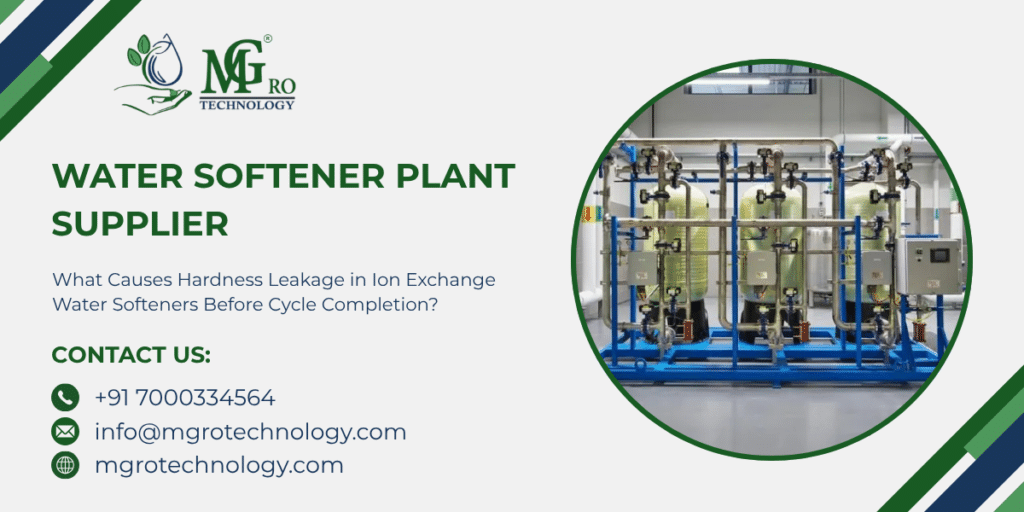
In pharmaceutical processing, commercial steam generation, textile finishing, and food manufacturing facilities, strict water hardness limits must be maintained continuously. Industrial water softeners are designed to deliver zero-hard product water by extracting calcium and magnesium cations across synthetic resin exchange sites.
Achieving continuous, zero-hardness effluent relies on the operational performance of an engineered Water Softener Plant.
An industrial ion-exchange water softener incorporates strong acid cation resin beds, internal distribution laterals, pressure vessel shells, and automated multi-port control valves engineered to achieve efficient sodium-for-hardness exchange.
Experiencing early hardness leakage before reaching calculated volumetric cycle limits leads to unnoticed mineral scale accumulation in downstream equipment, unexpected RO membrane scaling, product batch contamination, high chemical consumption, and costly unscheduled maintenance. Understanding the theoretical root causes governing fluid channelling, exchange zone migration, equilibrium mass-action displacement, and resin physical fouling enables water treatment engineers to protect soften stream quality. This comprehensive diagnostic guide provides an in-depth theoretical analysis of what causes hardness leakage in ion exchange water softeners before cycle completion.
Theoretical Kinetics of Exchange Zone Migration and Leakage
Ion exchange softening occurs within a dynamic mass transfer wave that moves progressively down the resin bed during service cycles:
+-----------------------------------------------------------------+
|                   INCOMING HIGH-HARDNESS RAW WATER              |
| (Calcium & magnesium ions enter the upper active resin layer)   |
+-----------------------------------------------------------------+
                                  |
                                  v
+-----------------------------------------------------------------+
|                   ACTIVE MASS TRANSFER ZONE (MTZ)               |
| (Primary ion exchange occurs; hardness replaces sodium ions)    |
+-----------------------------------------------------------------+
                                  |
                                  v
+-----------------------------------------------------------------+
|             EXHAUSTION & EARLY HARDNESS BREAKTHROUGH            |
| (MTZ reaches bottom polished layer, releasing hardness ions)    |
+-----------------------------------------------------------------+
1. Mass Transfer Zone Dynamics and Bed Exhaustion
Theoretical Principle: During service operation, ion exchange does not occur simultaneously across the entire resin column. Instead, it takes place within a moving band called the Mass Transfer Zone (MTZ). Above this zone, the resin is fully exhausted; below it, the resin remains in the active sodium form.
Premature Breakthrough: If hydraulic flow distribution is non-uniform or service flow rates exceed kinetic mass transfer limits, the Mass Transfer Zone expands rapidly. The bottom polished layer becomes prematurely saturated, allowing unexchanged calcium and magnesium cations to leak into the effluent water stream.
2. Fluid Channelling and Preferred Flow Path Mechanics
Theoretical Principle: Uniform fluid distribution across the entire resin bed cross-section is essential for maximum contact time. If raw feed water encounters compacted resin pockets, broken distribution laterals, or gas binding, it establishes high-velocity short-circuit paths or “channels.”
Bypass Consequences: Water flowing through these localized channels quickly exhausts adjacent resin exchange sites while leaving large portions of the surrounding resin bed unutilized. This leads to immediate hardness leakage despite the bulk of the resin bed having substantial remaining capacity.
In-Depth Analysis of Hardness Leakage Root Causes
Evaluating chemical equilibrium factors and physical resin degradation mechanics helps identify key causes of early hardness leakage:
Inadequate Brine Concentration or Dosage: Insufficient salt concentration or inadequate brine draw contact time during regeneration fails to fully convert the bottom layer of resin to the sodium form, resulting in immediate residual hardness leakage at the start of the next service cycle.
Excessive Raw Water TDS and Sodium Counter-Ion Interference: High background sodium levels in raw feed water create chemical mass-action opposition. Elevated sodium ion concentration competes with hardness cations for exchange sites, shifting equilibrium balance and driving premature hardness leakage.
Resin Bead Oxidation and Physical Degradation: Free chlorine, chloramines, or strong oxidizing agents break chemical cross-linking bonds within the resin matrix. This causes the resin beads to swell, lose structural rigidity, fragment, and release bound hardness ions back into the process stream.
Fouling by Iron, Manganese, or Suspended Particulates: Dissolved iron and manganese ions oxidize into insoluble metal hydroxides inside resin pore channels. This foulant coating blocks functional sulfonic acid exchange sites and restricts access to active sodium ions.
System Integration Across Industrial Water Treatment Infrastructure
Industrial water softeners operate as vital pre-treatment infrastructure across integrated industrial process networks:
Primary Hardness Removal: Calcium and magnesium extraction is performed through a high-capacity Water Softener Plant.
Downstream Membrane Protection: Softener effluent protects high-rejection elements in an Industrial RO Plant and premium Industrial RO Membrane from inorganic mineral scaling.
Wastewater Treatment Integration: Softened water usage minimizes scaling across downstream Effluent Treatment Plant and Sewage Treatment Plant installations.
Thermal System Protection: Hardness-free water feed prevents scale deposition inside an Industrial Water Chiller and process boiler loops.
Comprehensive Turnkey Manufacturing: System design, pressure vessel fabrication, and valve integration are delivered by a trusted Water Treatment Plant MFG.
Theoretical Best Practices to Prevent Hardness Leakage
To eliminate premature hardness breakthrough and optimize ion-exchange performance, design engineers follow three core theoretical guidelines:
Optimize Internal Fluid Distribution Systems: Ensure top inlet distributors and bottom collection laterals maintain balanced, low-velocity fluid distribution to prevent localized channelling across the resin bed.
Incorporate Pre-Filter Dechlorination Protection: Install active carbon filtration or chemical bisulfite injection upstream of the softener to eliminate free chlorine oxidant exposure and preserve resin bead matrix integrity.
Execute Counter-Current Regeneration Design: Utilize counter-current regeneration direction to ensure the final exit layer of the resin bed receives fresh, highly concentrated brine first, maintaining an ultra-polished sodium-form barrier.
Conclusion
Understanding the theoretical causes of premature hardness leakage is essential for maintaining reliable zero-hardness water production in industrial water softening plants. By controlling fluid distribution, eliminating oxidant exposure, maintaining brine saturation standards, and preventing foulant accumulation, industrial facilities ensure complete ion-exchange capacity utilization and protect critical downstream assets.
Looking for Premium Industrial Water Treatment and Filtration Solutions? Explore our complete range of high-capacity Water Softener Plant units, high-efficiency Industrial RO Plant setups, advanced Industrial RO Membrane options, industrial Effluent Treatment Plant and Sewage Treatment Plant installations, precise Industrial Water Chiller systems, and custom engineering from a leading Water Treatment Plant MFG at MGRO Technology. Contact our expert engineering team today.
 Users Today : 13
 Users This Month : 743
 Total Users : 787