
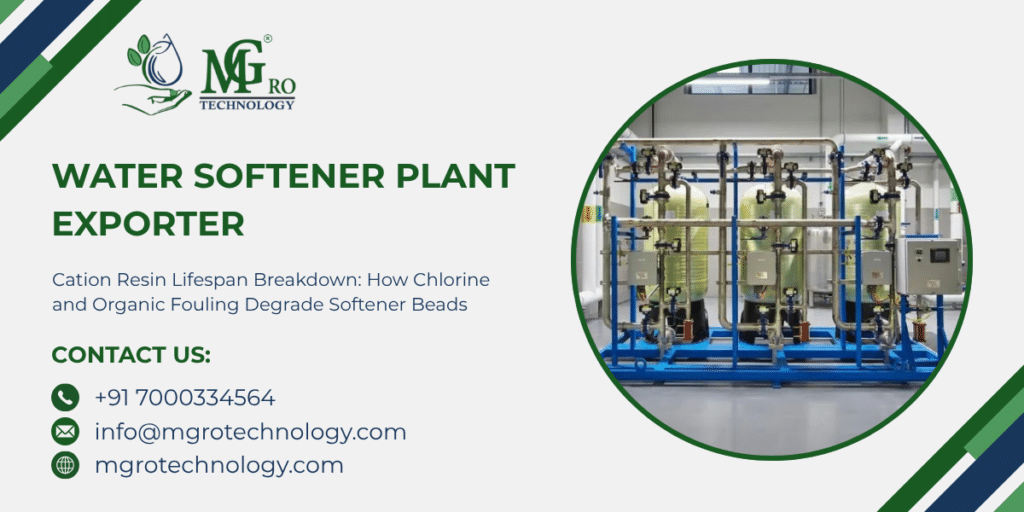
In pharmaceutical purified water generation, chemical manufacturing, commercial steam plants, and food processing operations, long-term stability of ion-exchange media is essential. Water softening systems rely on high-capacity synthetic resin beads to extract hardness cations from incoming raw water supplies.
Ensuring continuous zero-hardness water production depends fundamentally on maintaining healthy media inside a Water Softener Plant.
An industrial water softening assembly utilizes strong acid cation resin beads synthesized from styrene-divinylbenzene copolymers, functionalized with sulfonic acid exchange groups, housed within high-pressure vessels.
Operating ion-exchange softeners without protecting resin beds against incoming chemical oxidants and natural organic matter leads to rapid resin polymer oxidation, severe bead decapsulation, excessive moisture retention, bed compaction pressure spikes, and premature media replacement. Understanding the core theoretical mechanisms governing free chlorine oxidation, divinylbenzene cross-link cleavage, organic foulant pore blockage, and resin osmotic shock allows plant engineers to maximize media operational lifespan. This comprehensive technical guide provides an in-depth theoretical breakdown of how chlorine exposure and organic fouling degrade cation softener beads.
Theoretical Degradation Mechanics of Synthetic Resin Beads
Resin degradation occurs through two primary environmental attack mechanisms: chemical polymer oxidation and physical organic surface blockage:
+-----------------------------------------------------------------+
|                   INCOMING RAW WATER CONTAMINANTS               |
| (Free chlorine oxidants & natural organic matter enter bed)     |
+-----------------------------------------------------------------+
                                  |
                                  v
+-----------------------------------------------------------------+
|               CHEMICAL OXIDATION & CROSS-LINK CLEAVAGE          |
| (Chlorine attacks DVB bonds, causing bead swelling & softness) |
+-----------------------------------------------------------------+
                                  |
                                  v
+-----------------------------------------------------------------+
|             ORGANIC PORE FOULING & CAPACITY LOSS                |
| (Large organic molecules block access to exchange sites)        |
+-----------------------------------------------------------------+
1. Free Chlorine Attack and Polymer Cross-Link Cleavage
Theoretical Principle: Strong acid cation resin beads maintain structural rigidity via divinylbenzene (DVB) cross-linking agents that hold the polystyrene polymer matrix together. Exposure to free chlorine, chloramines, or ozone initiates severe oxidative cleavage of these DVB cross-links.
Oxidative Swelling and Structural Loss: As cross-linking bonds break, the resin bead structure absorbs excessive water, causing the beads to swell, lose physical density, and soften into a gel-like consistency. This physical degradation leads to bead fragmentation, fine particle generation, high pressure drops, and loss of volumetric exchange capacity.
2. Natural Organic Matter Surface Fouling and Pore Blockage
Theoretical Principle: Raw water supplies frequently contain complex, high-molecular-weight Natural Organic Matter (NOM), such as humic and fulvic acids. These hydrophobic organic compounds diffuse into the porous resin matrix, binding strongly to exchange sites.
Fouling Mechanisms: Large organic molecules become physically trapped within microscopic resin pores. This organic coating blocks functional sulfonic acid groups, preventing hardness cations from accessing active exchange sites and causing rapid capacity decline.
Comprehensive Analysis of Resin Breakdown Indicators
Recognizing physical and chemical indicators of resin degradation helps operators implement timely preventative measures:
Rising Moisture Content and Bead Softening: An increase in resin moisture retention capacity directly reflects the loss of internal DVB cross-linking, signaling severe chemical oxidation damage.
Excessive Pressure Drop Across the Resin Bed: As oxidized resin beads fragment into microscopic fines under hydraulic flow pressure, the fine particles pack tightly within the media bed, causing steep differential pressure increases.
Fines Generation and Resin Loss During Backwash: Mechanically degraded, swollen resin beads exhibit lower physical density, causing broken particles to wash out the top of the vessel during routine backwash cycles.
Fouling by Polyvalent Iron and Heavy Metals: Dissolved iron and manganese ions penetrate deep into resin pores, oxidizing into insoluble metal hydroxides that permanently block functional exchange sites.
System Integration Across Industrial Water Treatment Infrastructure
Industrial water softeners operate as vital pre-treatment infrastructure across integrated industrial process networks:
Primary Hardness Removal: Calcium and magnesium extraction is performed through a high-capacity Water Softener Plant.
Downstream Membrane Protection: Softener effluent protects high-rejection elements in an Industrial RO Plant and premium Industrial RO Membrane from inorganic mineral scaling.
Wastewater Treatment Integration: Softened water usage minimizes scaling across downstream Effluent Treatment Plant and Sewage Treatment Plant installations.
Thermal System Protection: Hardness-free water feed prevents scale deposition inside an Industrial Water Chiller and process boiler loops.
Comprehensive Turnkey Manufacturing: System design, pressure vessel fabrication, and valve integration are delivered by a trusted Water Treatment Plant MFG.
Theoretical Best Practices for Resin Preservation
To extend cation resin operational lifespan and protect ion-exchange media from chemical degradation, design engineers follow three core theoretical guidelines:
Install Upstream Dechlorination Equipment: Incorporate activated carbon filtration vessels or sodium bisulfite chemical injection upstream of the softener to ensure zero free chlorine contacts resin beds.
Implement Regular Resin Cleaning Sanitation Cycles: Perform periodic specialized brine washes combined with resin cleaners to strip accumulated organic matter, iron deposits, and surface foulants from the media bed.
Control Backwash Flow Velocities and Thermal Stress: Adjust backwash flow rates to match water temperature variations, preventing hydraulic turbulence from physically crushing fragile or aging resin beads.
Conclusion
Understanding how chlorine exposure and organic fouling degrade cation resin beads is essential for preserving high-capacity ion-exchange media and maintaining cost-effective water softening operations. By protecting resin beds from chemical oxidants, managing organic foulants, and monitoring resin physical health, industrial facilities ensure continuous high-efficiency hardness removal and extend equipment lifespan.
Looking for Premium Industrial Water Treatment and Filtration Solutions? Explore our complete range of high-capacity Water Softener Plant units, high-efficiency Industrial RO Plant setups, advanced Industrial RO Membrane options, industrial Effluent Treatment Plant and Sewage Treatment Plant installations, precise Industrial Water Chiller systems, and custom engineering from a leading Water Treatment Plant MFG at MGRO Technology. Contact our expert engineering team today.
 Users Today : 13
 Users This Month : 743
 Total Users : 787