
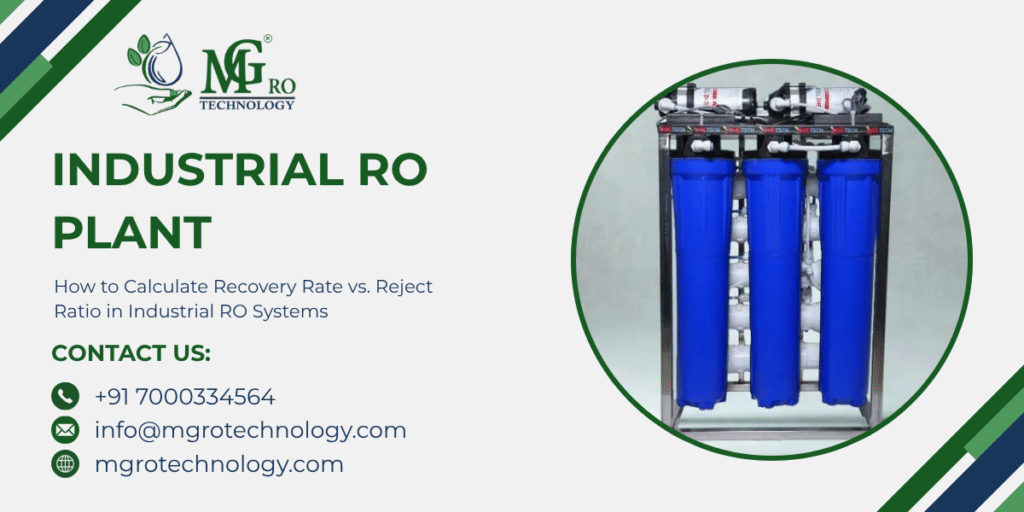
In modern pharmaceutical manufacturing, textile processing, chemical synthesis, and heavy manufacturing industries, reliable access to high-purity process water is essential. Raw water supplies contain varying concentrations of dissolved solids, mineral salts, colloidal silica, and organic impurities that must be systematically removed through membrane separation technology.
Achieving high-purity water output while optimizing raw water utilization depends fundamentally on an engineered Industrial RO Plant (Industrial Reverse Osmosis System).
An industrial reverse osmosis system utilizes semi-permeable spiral-wound membranes, high-pressure booster pumps, pre-filtration media vessels, chemical dosing skids, and automated flow control assemblies to separate pure water from concentrated mineral streams.
Operating an industrial reverse osmosis system without managing the dynamic balance between permeate production and concentrate rejection leads to rapid membrane scaling, severe concentration polarization, premature element fouling, excessive energy consumption, and high operational costs. Understanding the theoretical mechanics governing permeate recovery efficiency, reject stream proportions, osmotic pressure gradients, and concentration limits enables plant engineers to maximize membrane lifespan. This comprehensive technical guide provides an in-depth theoretical analysis of recovery rate versus reject ratio concepts in industrial reverse osmosis systems.
Theoretical Separation Mechanics in Industrial Reverse Osmosis
Reverse osmosis filtration relies on cross-flow membrane filtration, dividing pressurized feed water into two distinct hydro-dynamic streams:
+-----------------------------------------------------------------+
|                    HIGH-PRESSURE INCOMING FEED                  |
| (Pressurized water containing dissolved mineral salts & organics)|
+-----------------------------------------------------------------+
                                  |
                                  v
+-----------------------------------------------------------------+
|               SEMI-PERMEABLE MEMBRANE CROSS-FLOW                |
| (Water molecules pass through polymer layers; salts are rejected)|
+-----------------------------------------------------------------+
                 /                               \
                v                                 v
+-------------------------------+ +-------------------------------+
|    PURIFIED PERMEATE STREAM   | |  CONCENTRATED REJECT STREAM   |
| (Low-TDS clean product water) | | (High-TDS waste brine stream) |
+-------------------------------+ +-------------------------------+
1. Permeate Recovery Proportions and Osmotic Pressure Dynamics
Theoretical Principle: The recovery rate represents the percentage of total raw feed water volume that passes through the semi-permeable membrane as purified product permeate. As clean water permeates through the membrane matrix, the remaining feed water becomes increasingly concentrated with rejected mineral ions.
Osmotic Resistance Building: As permeate extraction increases, the osmotic pressure of the concentrated boundary layer rises exponentially. This requires higher hydraulic feed pressure to maintain continuous water flux through downstream membrane elements.
2. Concentrate Reject Ratio and Concentration Polarization
Theoretical Principle: The reject ratio represents the proportion of feed water diverted to the drain as brine concentrate. Maintaining an adequate reject flow velocity is vital to sweep accumulated mineral salts, colloidal silica, and suspended particulates away from the active membrane surface.
Scaling Prevention: Operating below minimum recommended reject flow velocities causes severe concentration polarization. Mineral salts exceed their solubility limits, precipitating as hard scale crystals that block microscopic membrane pores permanently.
Deep Dive into Recovery vs Reject Dynamics
Understanding system metrics and their operational impact is critical for maintaining overall filtration balance:
Permeate Recovery Efficiency: The ratio of purified product water output determines raw water volumetric efficiency. However, pushing recovery rates beyond theoretical limits causes severe mineral saturation and scaling on downstream membrane surfaces.
Concentrate Reject Velocity: The ratio of concentrated waste stream flow acts as a continuous flushing mechanism. Insufficient reject flow velocity fails to sweep rejected ions away from the active membrane layer, accelerating foulant deposition.
Osmotic Pressure Gradient: As dissolved solid concentration increases in the brine stream, natural osmotic pressure opposes net fluid flux across the membrane barrier. Overcoming this chemical potential difference requires elevated hydraulic feed pump energy.
Concentration Factor Limits: The ratio of salt concentration in the reject stream directly determines mineral precipitation risk. Exceeding specific chemical solubility thresholds precipitates calcium, magnesium, and silica scale crystals.
System Integration Across Industrial Water Treatment Infrastructure
Industrial reverse osmosis plants operate as part of a comprehensive, multi-stage water treatment and purification ecosystem:
Primary Membrane Separation: High-purity product water generation and salt rejection depend on an engineered Industrial RO Plant.
High-Performance Separation Elements: Long-term filtration stability requires selecting a premium Industrial RO Membrane suited to feed water chemistry.
Hardness Removal & Scale Prevention: Pre-treating raw water with a high-capacity Water Softener Plant eliminates calcium and magnesium scaling risks prior to membrane entry.
Industrial Wastewater Recycling: Process wastewater streams are treated and reclaimed using advanced Effluent Treatment Plant and Sewage Treatment Plant systems.
Thermal Regulation & Water Cooling: Precise operating fluid temperatures are maintained across industrial processes using a heavy-duty Industrial Water Chiller.
Comprehensive Turnkey Manufacturing: System integration, skid fabrication, and custom engineering are executed by an experienced Water Treatment Plant MFG.
Theoretical Best Practices for System Efficiency
To maintain long-term membrane performance and optimize overall system efficiency in industrial reverse osmosis installations, design engineers follow three core theoretical guidelines:
Conduct Dynamic Feedwater Scaling Analysis: Perform thorough chemical analysis of raw feedwater to calculate calcium sulfate, barium sulfate, and silica saturation indices before setting target recovery levels.
Utilize Multi-Stage Array Configurations: Implement multi-stage vessel arrays to maintain adequate cross-flow velocity across downstream membrane elements, distributing salt loading evenly across all stages.
Incorporate Automated Flushes and Antiscalant Dosing: Configure continuous antiscalant chemical injection combined with periodic low-pressure permeate flushes to dissolve boundary layer mineral accumulation before crystallization occurs.
Conclusion
Understanding the theoretical relationship between recovery rates and reject ratios is essential for designing, operating, and maintaining efficient industrial reverse osmosis systems. By balancing permeate production with adequate concentrate velocity, industrial facilities maximize water recovery, prevent premature membrane degradation, and maintain stable long-term purification performance.
Looking for Premium Industrial Water Treatment and Filtration Solutions? Explore our complete range of high-efficiency Industrial RO Plant setups, advanced Industrial RO Membrane options, heavy-duty Water Softener Plant units, industrial Effluent Treatment Plant and Sewage Treatment Plant installations, precise Industrial Water Chiller systems, and custom engineering from a leading Water Treatment Plant MFG at MGRO Technology. Contact our expert engineering team today.
 Users Today : 0
 Users This Month : 730
 Total Users : 774