
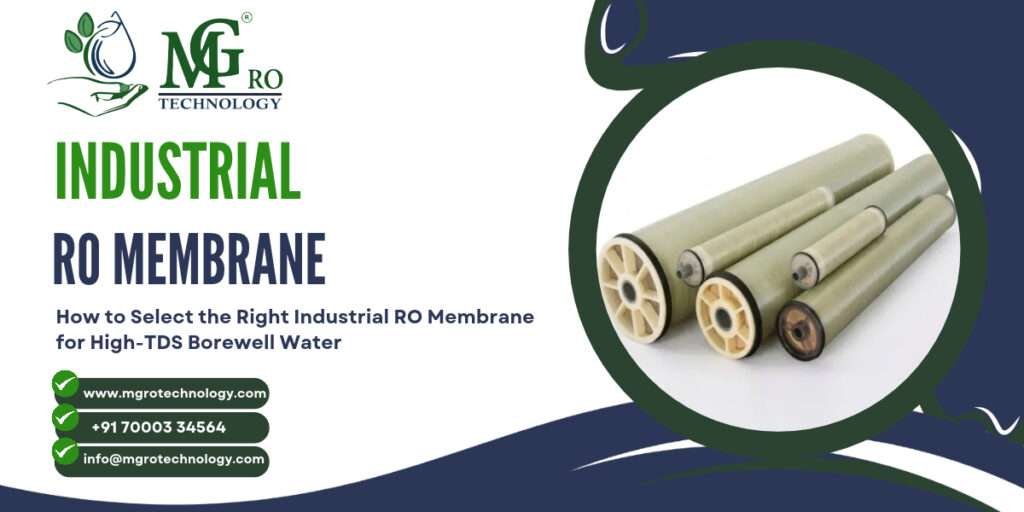
Sourcing feed water from deep underground borewells often means dealing with high Total Dissolved Solids (TDS), elevated hardness, silica, and variable mineral concentrations. When designing or upgrading an Industrial RO Plant, selecting the correct reverse osmosis (RO) membrane is the most critical decision for long-term operational success.
Installing standard low-pressure tap water membranes in a high-TDS industrial environment leads to rapid salt breakthrough, accelerated fouling, and premature membrane failure. Understanding the core theoretical criteria for membrane selection ensures optimal purification performance and plant durability.
1. Understanding Feedwater Quality and Salinity Levels
Before selecting a membrane element, plant engineers must analyze the complete ionic composition of the raw water supply. High-TDS borewell water is generally classified into brackish water ranges, which require specialized composite elements rather than residential or low-pressure commercial components.
+-------------------------------------------------------------------------+
|                    MEMBRANE SELECTION BASED ON TDS                      |
+-------------------------------------------------------------------------+
| Low TDS             -> Energy-Saving / Low-Pressure Elements            |
|                                                                         |
| Medium TDS          -> Standard Brackish Water Elements                 |
|                                                                         |
| High TDS            -> High-Rejection / High-Pressure Elements          |
+-------------------------------------------------------------------------+
Brackish Water RO Membranes: Engineered specifically to handle elevated dissolved salt concentrations. They offer high structural strength to withstand the higher operating pressures required to overcome natural osmotic pressure.
High-Rejection Elements: Designed for applications where stringent product water purity is mandatory, ensuring maximum removal of sodium, chloride, calcium, and magnesium ions from difficult borewell sources.
2. Key Membrane Selection Criteria
When evaluating membrane elements from global manufacturers, engineers evaluate several core characteristics:
Salt Rejection Rate vs. Permeate Flow
Salt Rejection: The percentage of dissolved ions blocked by the membrane. High-TDS applications demand membranes with a high salt rejection rating to prevent contaminant slip into the product stream.
Active Surface Area: A larger active surface area per element allows higher permeate production at lower localized flux rates, reducing fouling potential in high-salinity water.
Feed Spacer Thickness (Mil Size)
The feed spacer mesh inserted between membrane sheets dictates how easily suspended particles and biological matter pass through the scroll element.
Standard Spacers: Suitable for low-turbidity, well-filtered water matrices.
Wider Spacers: Essential for high-TDS borewell waters with potential suspended solids or colloidal loading, as wider channels reduce physical plugging and lower differential pressure buildup.
3. Balancing Membrane Durability and Chemical Resistance
High-TDS borewell water often requires periodic Clean-In-Place (CIP) washes due to mineral scaling and biological activity. Therefore, membrane selection must account for chemical tolerance:
+-------------------------------------------------------------------------+
|               MEMBRANE DURABILITY & OPERATIONAL FACTORS                 |
+-------------------------------------------------------------------------+
| Wide pH Operating Range -> Withstands low-pH acid and high-pH cleaning  |
|                                                                         |
| Structural Support      -> Reinforced fiberglass shell for stability   |
|                                                                         |
| Anti-Fouling Layer      -> Surface modifications to repel organics      |
+-------------------------------------------------------------------------+
pH Tolerance During CIP: Membranes must endure aggressive cleaning solutions—low-pH acids for calcium carbonate and metal scaling, and high-pH alkaline detergents for biological and organic fouling—without degrading the active polyamide layer.
Fiberglass Outer Wrap: High-pressure industrial systems require fully fiberglass-wrapped elements to prevent structural distortion and mechanical failure under high differential pressures.
Summary of Best Practices for Membrane Selection
Design for Peak Variations: Always select membrane arrays based on peak seasonal TDS levels rather than average or post-monsoon water quality.
Prioritize Fouling Resistance: For complex borewell matrices, select fouling-resistant elements with modified surface charges that naturally repel organic and colloidal foulants.
Integrate Upstream Pre-Treatment: Even high-grade RO membranes will fail prematurely if upstream pre-treatment (such as a Water Softener Plant or multi-grade filtration) is omitted.
Upgrade Your Industrial Water System
Selecting the ideal RO membrane ensures lower energy consumption, reduced chemical cleaning frequency, and consistent treated water quality for your manufacturing plant.
MGRO Technology designs, manufactures, and supplies custom-engineered Industrial RO Plants, Water Softener Plants, and Effluent Treatment Plants (ETP) tailored to your specific water source.
Contact MGRO Technology Engineers Today for expert guidance on membrane selection and plant design.
 Users Today : 6
 Users This Month : 726
 Total Users : 770