
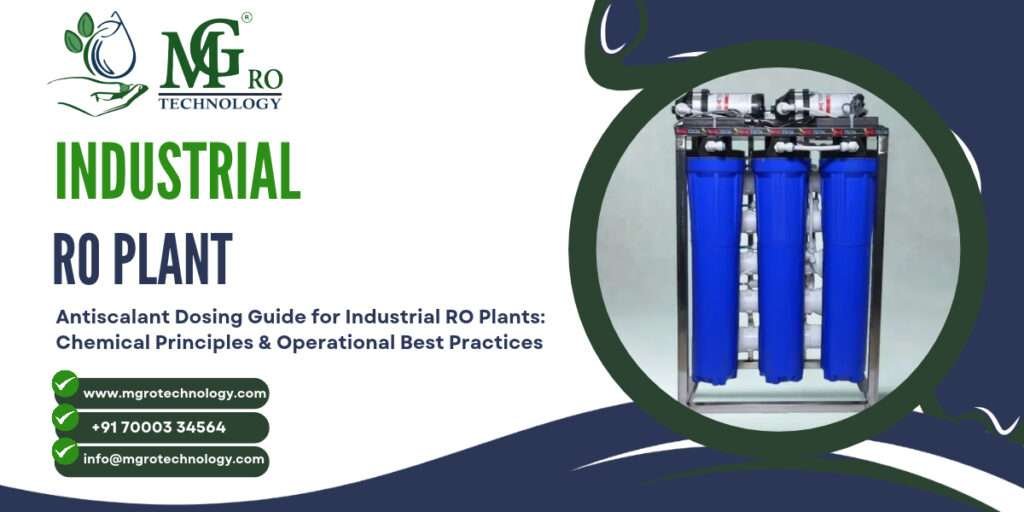
During the operation of an Industrial RO Plant, purified water passes through the membrane elements while dissolved minerals and salts concentrate toward the reject (concentrate) stream. As the volume of water decreases along the length of the pressure vessel, the concentration of dissolved ions increases significantly.
If left untreated, these super-saturated minerals precipitate out of solution and deposit dense crusts onto the active membrane surface—a destructive phenomenon known as mineral scaling.
To prevent scaling and protect system performance, operators must continuously dose specialized antiscalant chemicals upstream of the high-pressure pump. This guide explores the chemical mechanisms, types of antiscalants, and operational best practices governing effective antiscalant dosing.
1. How Antiscalant Chemicals Work (Theoretical Mechanisms)
Antiscalants are sophisticated formulation polymers and phosphonates designed to interact with mineral ions before they can form rigid crystal lattices. They operate through three primary chemical mechanisms:
+-------------------------------------------------------------------------+
|                    ANTISCALANT WORKING MECHANISMS                       |
+-------------------------------------------------------------------------+
| Threshold Inhibition   -> Delays crystal nucleation and precipitation   |
|                                                                         |
| Crystal Distortion     -> Modifies crystal structure to prevent bonding |
|                                                                         |
| Dispersion Action      -> Keeps micro-crystals suspended in water flow  |
+-------------------------------------------------------------------------+
Threshold Inhibition: When mineral ions exceed their normal solubility limits, antiscalant molecules interfere with the initial formation stage (nucleation), significantly delaying crystal growth.
Crystal Distortion (Modification): If micro-crystals begin to form, antiscalant molecules adsorb onto the crystal growth sites. This alters the physical shape of the crystal, making it deformed, weak, and incapable of adhering to the polyamide membrane surface.
Dispersion: Antiscalants impart a negative electrical charge to suspended mineral micro-crystals. Because like charges repel each other, the particles remain suspended in the bulk solution and pass out through the reject stream rather than settling on the membrane.
2. Common Mineral Scaling Risks Addressed by Antiscalants
Different raw water sources present unique scaling challenges. Selecting the correct antiscalant formulation depends on identifying the dominant mineral compounds:
Calcium Carbonate Scale: Formed when bicarbonate and calcium ions react under elevated pH and pressure conditions, common in standard borewell supplies.
Calcium and Barium Sulfate: Highly insoluble mineral deposits that form hard, stubborn crystal layers on tail-end elements.
Silica Polymerization: Dissolved silica can polymerize into a glassy, abrasive layer if concentration polarization exceeds safe operating thresholds. Specialist silica-dispersing antiscalants are required for high-silica water matrices.
3. Operational Best Practices for Dosing System Setup
Ensuring that antiscalant chemicals protect your membrane array efficiently requires adherence to strict operational protocols:
+-------------------------------------------------------------------------+
|                  DOSING SYSTEM SETUP BEST PRACTICES                     |
+-------------------------------------------------------------------------+
| Injection Point    -> Positioned upstream of the 5-micron cartridge     |
|                                                                         |
| Dilution Standard  -> Always dilute using pure RO permeate water        |
|                                                                         |
| Continuous Control -> Ensure synchronized dosing whenever booster runs  |
+-------------------------------------------------------------------------+
Optimal Injection Location: Antiscalant should be injected continuously through a dedicated chemical metering pump into the feed line before the 5-micron cartridge filter. This ensures the chemical mixes thoroughly with the feedwater before reaching the high-pressure pump and pressure vessels.
Dilution Water Quality: Always dilute concentrated antiscalant chemicals using pure RO permeate water. Mixing concentrated chemicals with raw or hard water can cause premature precipitation inside the chemical day tank.
Avoiding Under-Dosing and Over-Dosing:
Under-dosing leaves tail-end elements vulnerable to rapid mineral scaling and permanent flux loss.
Over-dosing can cause excess polymer residue to react with feedwater constituents, creating organic fouling deposits on the membrane spacer mesh.
Summary of Best Practices
Integrating a reliable antiscalant dosing system stabilizes plant recovery rates, extends membrane element lifespan, and reduces the frequency of aggressive chemical cleaning cycles.
To build a complete water treatment strategy, antiscalant dosing should work in harmony with proper pre-treatment systems such as a Water Softener Plant or multi-grade filtration.
Optimize Your Water Treatment Plant
Experiencing scaling issues, pressure drops, or frequent membrane fouling in your facility?
MGRO Technology designs, manufactures, and services high-efficiency Industrial RO Plants, Water Softener Plants, and Effluent Treatment Plants (ETP) engineered for reliability and performance.
Contact MGRO Technology Engineers Today for professional system audits and custom plant design.
 Users Today : 6
 Users This Month : 726
 Total Users : 770