If your factory uses borewell or ground water, hard water is likely creating hidden expenses in your daily operations. Hard water contains high amounts of dissolved minerals like calcium that stick to hot metal surfaces, forming a rock-hard white layer known as scale build-up.
Inside steam boilers, cooling towers, heat exchangers, and plumbing lines, scale acts like a thermal blanket. It stops heat from transfering properly, causing your electricity or fuel bills to shoot up while damaging expensive machinery.
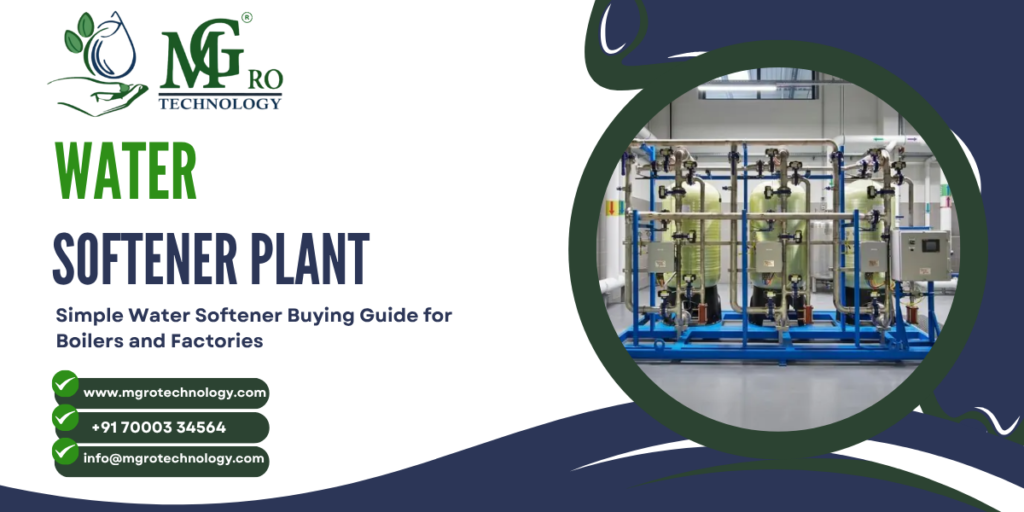
Installing an industrial Water Softener Plant removes hard minerals completely before water enters your critical equipment.
Here is a simple buyer’s guide to help you pick the right water softener for your plant.
1. How a Water Softener Protects Your Equipment
A water softener contains thousands of tiny resin beads inside a vertical pressure vessel. As hard water passes through these resin beads, hardness minerals are trapped and replaced with soft sodium ions.
For Steam Boilers: Prevents dangerous scale layers inside boiler tubes, avoiding tube failure and high fuel consumption.
For Cooling Towers: Prevents scale inside condenser pipes, keeping cooling efficiency high during peak summer months.
For RO Systems: Acts as an ideal pre-filter before an Industrial RO Plant, protecting delicate Industrial RO Membranes from mineral choking.
2. Key Things to Consider Before Buying
To get the right size machine from a manufacturer, you only need to know three basic details:
A. Your Daily Water Consumption
How many liters of softened water does your factory need in a day or during one work shift? (e.g., 10,000 liters/day or 50,000 liters/day).
B. Your Water Hardness Level
Check your raw water lab test report for Total Hardness. Water hardness is usually rated as:
Mild Hardness: Taps show minor white spots.
Moderate Hardness: Noticeable scaling inside pipes and heaters.
Heavy Hardness: Thick white crust forms rapidly on all water equipment.
C. Manual vs. Automatic Operation
Manual Multiport Valve: Requires a plant worker to turn the valve handle manually every few days to wash the resin with salt water.
Automatic Multiport Valve: Automatically washes and recharges the resin bed at scheduled times without needing manual labor.
3. Salt Washing (Regeneration) Made Simple
Over time, the resin beads inside the softener get full of trapped hardness minerals. To clean them, the system washes itself with a common salt solution (brine water).
This cleaning process is called Regeneration.
It takes about 45 to 60 minutes.
Regular commercial salt is added to a brine tank connected next to the softener vessel.
Once washed, the resin is fully recharged and ready to soften water again.
Summary Checklist for Buyers
| Factory Need | What Happens Without Softener | Solution Benefit |
| Boiler Feedwater | High fuel bills & tube damage | Zero scale & maximum heating efficiency |
| Cooling Towers | High temperature trips & pipe blockage | Smooth cooling & lower chemical costs |
| RO Plant Pre-Treatment | Rapid membrane choking | Doubles the lifespan of internal RO filters |
Final Recommendation
Investing in a quality water softener is one of the fastest ROI (Return on Investment) machinery purchases for any factory. The money you save on fuel, electricity, and reduced repair bills usually pays for the machine within a few months.
Explore our durable, easy-to-operate Water Softener Plant models built for heavy industrial usage.