
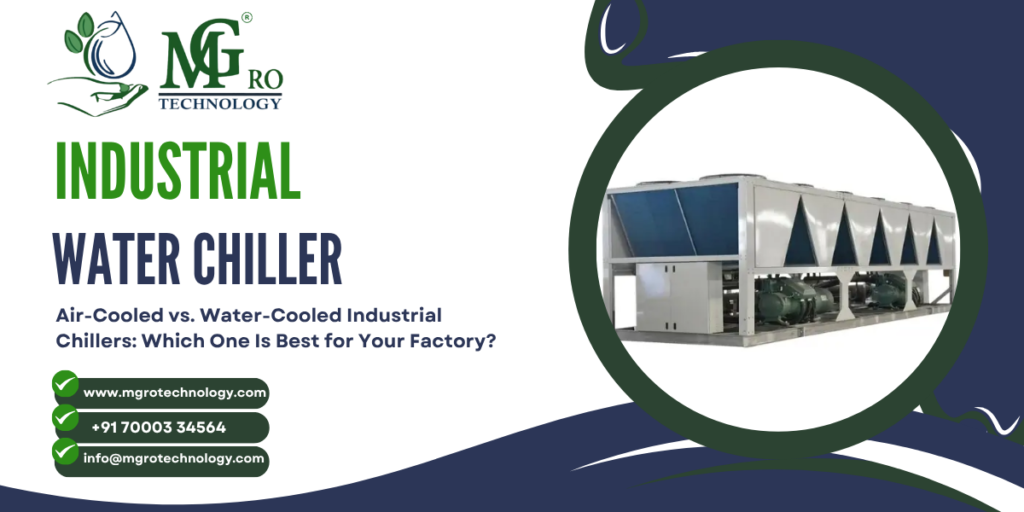
Industrial water chillers are essential for regulating temperatures in plastic molding, chemical processing, pharmaceutical manufacturing, food production, and laser cutting. A reliable chiller prevents machine overheating, maintains product quality, and keeps production lines running without expensive downtime.
When investing in an industrial chilling system, the primary decision comes down to two design types: Air-Cooled Chillers and Water-Cooled Chillers.
Both types serve the same basic purpose—removing heat from process water—but they operate differently and suit different facility environments.
Here is a straightforward guide to help you choose the right chiller system for your factory.
1. How They Work (The Basic Difference)
Air-Cooled Chiller:
Uses surrounding atmospheric air to cool down internal refrigerant gas.
Built with heavy-duty cooling fans on top or on the sides that blow heat directly into the surrounding air, much like a giant outdoor air conditioning unit.
Water-Cooled Chiller:
Uses water from an external cooling tower to absorb heat from the refrigerant gas.
Water circulates between the chiller unit and an outdoor cooling tower, carrying heat away efficiently through evaporation.
2. Space and Installation Requirements
Air-Cooled Chiller:
Installation: Simple and quick. It comes as a single compact unit with fewer connected pipes.
Location: Needs to be placed outdoors (on a roof or open terrace) or in a well-ventilated open area so fans can freely discharge hot air.
Water-Cooled Chiller:
Installation: Requires additional equipment, including a cooling tower, external water pumps, and extra piping.
Location: The chiller unit sits indoors in a basement or plant room, while the connected cooling tower is installed outside on a rooftop or open yard.
3. Cooling Efficiency & Electricity Usage
Air-Cooled Chiller:
Efficiency depends heavily on outdoor weather. During hot summer days when ambient temperatures spike, fans work harder, slightly increasing power consumption.
Ideal for small to medium cooling loads where simple setup is preferred over maximum energy savings.
Water-Cooled Chiller:
Delivers higher cooling efficiency regardless of outdoor air temperature because water cools more effectively than air.
Consumes less electricity per ton of cooling in large industrial applications, making it ideal for continuous, high-volume production plants.
4. Water Availability & Maintenance
Air-Cooled Chiller:
Zero Process Water Consumption: Does not require a continuous water supply to reject heat. Perfect for areas with water scarcity or high water costs.
Maintenance: Low maintenance. Routine upkeep involves cleaning air filter coils and inspecting fan motors.
Water-Cooled Chiller:
Requires Continuous Water: Needs a steady supply of makeup water to compensate for evaporation in the cooling tower.
Maintenance: Requires regular checks to prevent scaling, algae growth, or pipe rust inside cooling tower lines.
For plants using water-cooled systems, installing an upstream Water Softener Plant keeps cooling tower pipes clean and scale-free, maximizing heat transfer efficiency.
Quick Comparison Summary
| Feature | Air-Cooled Industrial Chiller | Water-Cooled Industrial Chiller |
| Heat Rejection Method | Air Fans | Water + External Cooling Tower |
| System Complexity | Simple, All-in-One Unit | Requires Cooling Tower & Extra Pumps |
| Installation Space | Outdoors / Well-Ventilated Area | Indoor Plant Room + Outdoor Tower |
| Water Requirement | None (Water-Free Heat Release) | Continuous Water Supply Needed |
| Power Efficiency | Good for Small/Medium Loads | Highest Efficiency for Large Heavy Loads |
| Maintenance Needs | Low (Fan & Coil Cleaning) | Moderate (Tower & Pipe Scale Control) |
Which One Should You Buy?
Choose an Air-Cooled Chiller if you have limited indoor space, want a simple plug-and-play installation, or operate in an area with water shortages.
Choose a Water-Cooled Chiller if your factory runs heavy 24/7 manufacturing shifts, has high cooling demands, and wants the lowest possible long-term power bills.
Looking to optimize process cooling in your plant? Explore our durable industrial cooling and Industrial RO Plant solutions built for heavy industrial usage.