
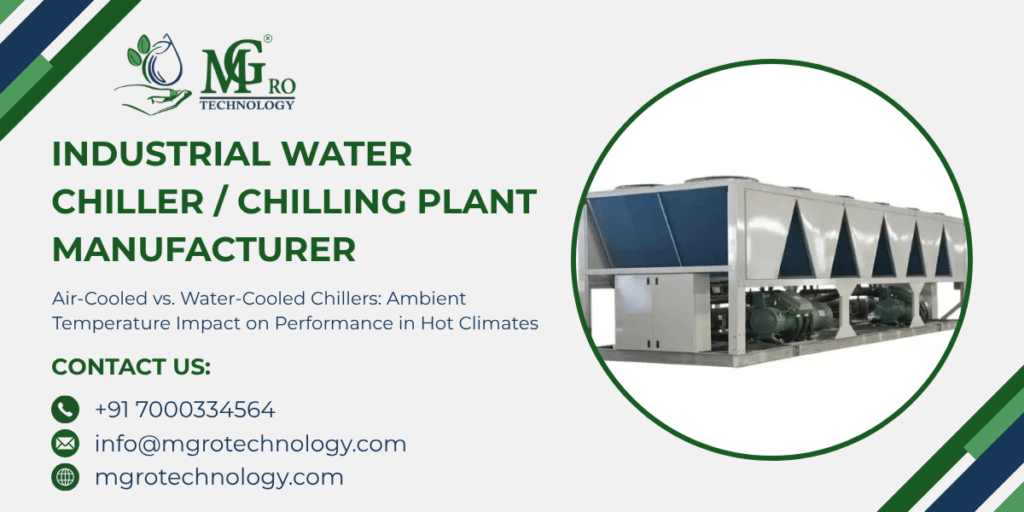
In chemical processing plants, plastic manufacturing lines, pharmaceutical cleanrooms, and food processing facilities located in high-ambient tropical or arid regions, thermal heat dissipation is a primary operational challenge. Industrial chillers must continuously reject large volumes of process heat into surrounding atmospheric sinks while maintaining stable chilled fluid delivery.
Achieving efficient thermal rejection under extreme outdoor heat conditions depends fundamentally on selecting the right heat exchange architecture for an Industrial Water Chiller.
An industrial chilling plant utilizes air-cooled finned-coil condensers with axial fans or water-cooled shell-and-tube condensers paired with external evaporative cooling towers to condense high-pressure refrigerant gas back into a liquid state.
Selecting an unsuitable condenser configuration for hot climate environments leads to excessive head pressure trips, reduced refrigeration capacity, soaring electrical power consumption, frequent high-pressure cut-outs, and severe compressor thermal stress. Understanding the core theoretical thermodynamic principles governing dry-bulb atmospheric sensible heat exchange versus wet-bulb evaporative latent heat cooling enables facility engineers to make informed equipment decisions. This comprehensive technical guide provides an in-depth theoretical analysis comparing air-cooled and water-cooled chillers in high ambient temperature environments.
Theoretical Dynamics of Heat Dissipation and Condensing Thermodynamics
Condenser performance directly dictates compressor efficiency and net refrigeration capacity across varying atmospheric conditions:
+-----------------------------------------------------------------+
|                   HIGH-TEMPERATURE PROCESS HEAT LOAD            |
| (Evaporator absorbs heat, compressing refrigerant into hot gas) |
+-----------------------------------------------------------------+
                                  |
                                  v
+-----------------------------------------------------------------+
|               CONDENSER HEAT REJECTION & PHASE CHANGE           |
| (Air-Cooled: Ambient Dry-Bulb Air | Water-Cooled: Ambient Wet-Bulb Water)|
+-----------------------------------------------------------------+
                                  |
                                  v
+-----------------------------------------------------------------+
|             SUB-COOLED LIQUID REFRIGERANT RETURN                |
| (Refrigerant expands through expansion valve to repeat cooling) |
+-----------------------------------------------------------------+
1. Dry-Bulb vs. Wet-Bulb Temperature Driving Force
Theoretical Principle: Air-cooled condensers reject heat directly into surrounding ambient air via sensible heat transfer, making their performance dependent entirely on outdoor dry-bulb air temperature. As ambient dry-bulb temperatures rise during hot summer months, the temperature gradient between hot refrigerant gas and ambient air narrows.
Evaporative Latent Heat Advantage: Water-cooled chillers reject heat via evaporative cooling towers, where performance depends on ambient wet-bulb temperature rather than dry-bulb temperature. Because wet-bulb temperatures remain significantly lower than dry-bulb temperatures in hot, dry climates, water-cooled systems maintain lower condensing temperatures.
2. Compressor Lift and Thermodynamic Efficiency
Theoretical Principle: Compressor lift represents the pressure differential between suction pressure in the evaporator and discharge pressure in the condenser. Higher condensing temperatures increase discharge pressure, forcing the compressor to work against a greater pressure lift.
Energy Consumption Penalty: High compressor lift reduces volumetric efficiency and dramatically increases electrical power draw per ton of refrigeration. Water-cooled systems maintain lower condensing pressures in hot climates, offering superior thermodynamic coefficient of performance.
In-Depth Structural Comparison Between Air-Cooled and Water-Cooled Systems
Evaluating theoretical and practical operational characteristics highlights key differences between condenser architectures in high-ambient regions:
Air-Cooled Chiller System Mechanics: Air-cooled units feature simplified packaged designs requiring no external water makeup loops, chemical treatment skids, or cooling towers. However, in extreme ambient heat, elevated condensing temperatures reduce net cooling capacity when demand is highest.
Water-Cooled Chiller System Mechanics: Water-cooled units achieve stable condensing temperatures regardless of soaring outdoor dry-bulb temperatures. However, they require continuous makeup water supplies, cooling tower fans, water circulation pumps, and chemical treatment programs to manage scaling and bio-fouling.
Atmospheric Scaling and Corrosion Risk: Industrial facilities operating water-cooled chillers in dry, hot climates face rapid mineral concentration in cooling towers due to high evaporation rates, necessitating robust chemical water treatment.
Facility Footprint and Installation Constraints: Air-cooled chillers require outdoor roof or pad installations with unobstructed airflow to prevent hot air recirculation. Water-cooled chillers house compact refrigeration units indoors, but require dedicated outdoor space for cooling towers.
System Integration Across Industrial Water Treatment Infrastructure
Industrial water chillers operate as vital thermal regulation systems within integrated industrial facilities:
Process Thermal Regulation: Precision cooling for industrial machinery and chemical reactors is maintained using a heavy-duty Industrial Water Chiller.
Primary Hardness & Scale Protection: Cooling tower makeup water for water-cooled chillers is softened using a high-capacity Water Softener Plant to prevent scale formation inside condenser tubes.
High-Purity Water Supply: Ultra-pure process cooling water is generated using an advanced Industrial RO Plant fitted with high-rejection Industrial RO Membrane elements.
Wastewater & Effluent Cooling: Industrial wastewater streams are cooled prior to biological treatment or discharged using an engineered Effluent Treatment Plant.
Sanitary Sewage Purification: Facility sanitary wastewater is processed using a specialized Sewage Treatment Plant.
Comprehensive Turnkey Manufacturing: Plant engineering, skid fabrication, and chilling system integration are delivered by a trusted Water Treatment Plant MFG.
Theoretical Best Practices for Hot Climate Chiller Selection
To ensure reliable cooling performance and optimize energy consumption in high ambient temperature regions, design engineers follow three core theoretical guidelines:
Select Water-Cooled Architectures for High-Tonnage Continuous Loads: Specify water-cooled chillers for large industrial manufacturing facilities in hot climates where continuous baseline thermal energy efficiency is paramount.
Apply Ambient Temperature Derating for Air-Cooled Units: Size air-cooled chillers using peak local summer dry-bulb design temperatures rather than standard nominal rating conditions to account for capacity loss.
Implement Variable Speed Condenser Fans and Compressor Inverters: Incorporate variable-frequency drives on condenser fans and compressors to modulate system output dynamically as ambient temperatures fluctuate between day and night.
Conclusion
Understanding the thermodynamic differences between air-cooled and water-cooled chillers under high ambient temperature conditions is essential for designing reliable industrial cooling networks. By evaluating local dry-bulb and wet-bulb temperatures, compressor lift mechanics, water availability, and long-term energy budgets, industrial facilities achieve optimal heat rejection performance, protect critical manufacturing processes, and maintain continuous thermal control.
Looking for Precision Industrial Chilling and Water Treatment Solutions? Explore our complete range of high-efficiency Industrial Water Chiller units, heavy-duty Water Softener Plant installations, advanced Industrial RO Plant and Industrial RO Membrane systems, industrial Effluent Treatment Plant and Sewage Treatment Plant setups, and custom engineering from a leading Water Treatment Plant MFG at MGRO Technology. Contact our expert engineering team today.
 Users Today : 10
 Users This Month : 674
 Total Users : 718