
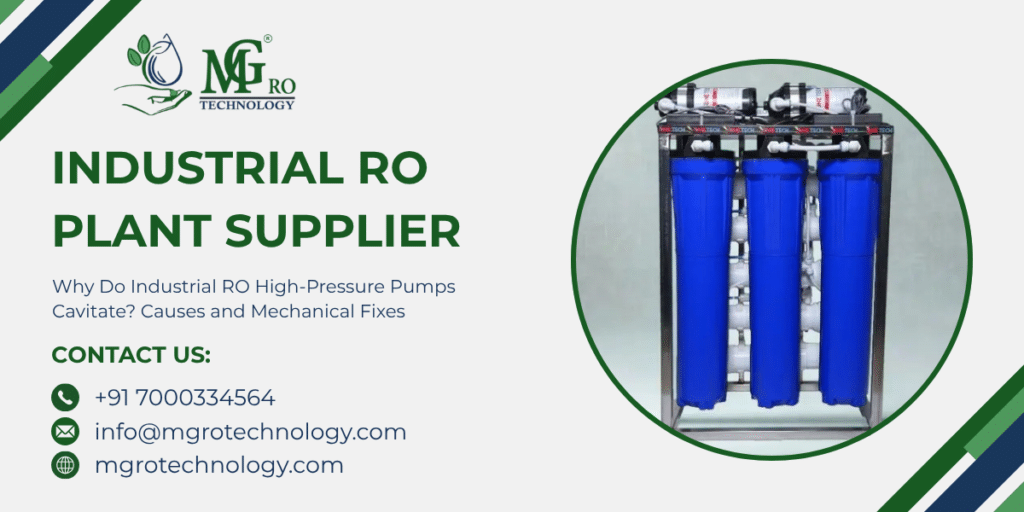
In continuous high-recovery desalination facilities, power generation plants, chemical process water systems, and industrial manufacturing plants, generating sufficient hydraulic driving force is critical. Membrane filtration processes require high feed pressures to overcome natural osmotic resistance and force water molecules through semi-permeable polymer layers.
Delivering this continuous hydraulic pressure depends fundamentally on the booster pump assembly within an Industrial RO Plant (Industrial Reverse Osmosis System).
An industrial reverse osmosis pumping system utilizes multi-stage vertical centrifugal or positive displacement high-pressure pumps, variable frequency drives, suction pressure transmitters, and protective interlock switches to feed raw water into pressure vessels.
Operating high-pressure pumps without maintaining proper suction head conditions leads to destructive hydraulic cavitation, violent mechanical vibration, internal impeller erosion, seal failures, and unexpected plant shutdowns. Understanding the core theoretical mechanics governing liquid vaporization thresholds, net positive suction head margins, micro-bubble collapse shockwaves, and suction line fluid dynamics allows mechanical engineers to prevent pump destruction. This comprehensive technical guide provides an in-depth theoretical analysis of why industrial RO high-pressure pumps cavitate, exploring root causes and mechanical design principles.
Theoretical Mechanics of Pump Cavitation
Pump cavitation occurs when localized hydraulic fluid pressure drops below the vapor pressure of the liquid, initiating a violent phase-change cycle:
+-----------------------------------------------------------------+
|               LOCALIZED FLUID PRESSURE DROP BELOW VAPOR POINT   |
| (Suction restriction creates localized pressure drop at inlet) |
+-----------------------------------------------------------------+
                                  |
                                  v
+-----------------------------------------------------------------+
|               MICRO VAPOR BUBBLE FORMATION & NUCLEATION         |
| (Dissolved gases & water vapor form microscopic bubbles)       |
+-----------------------------------------------------------------+
                                  |
                                  v
+-----------------------------------------------------------------+
|               HIGH-PRESSURE BUBBLE IMPLOSION & SHOCKWAVES       |
| (Bubbles move to high-pressure zones & collapse violently)     |
+-----------------------------------------------------------------+
1. Pressure Reduction and Vaporization Bubble Nucleation
Theoretical Principle: As fluid enters the eye of a pump impeller, local fluid velocity increases rapidly, causing a corresponding drop in static pressure according to hydraulic energy conservation principles. If localized pressure drops below the liquid’s saturation vapor pressure, microscopic vapor bubbles form instantaneously.
Vaporization Threshold: Inadequate net positive suction head available from booster pumps or pre-filtration vessels accelerates this vaporization, filling the impeller inlet channels with vapor pockets rather than solid liquid.
2. High-Pressure Shockwave Collapse and Material Erosion
Theoretical Principle: When vapor bubbles travel into the higher-pressure regions of the impeller vanes, the surrounding hydraulic pressure forces them to collapse violently. This micro-implosion creates extreme localized micro-jets and high-frequency shockwaves.
Mechanical Damage Profile: Repeated high-frequency micro-jets striking metal surfaces pit impeller vanes, erode pump casings, destroy mechanical seals, and generate characteristic metallic noise and severe structural vibration.
In-Depth Analysis of Cavitation Causes and Mechanical Fixes
Preventing cavitation requires analyzing root hydraulic causes and implementing sound mechanical design principles across the pump suction architecture:
Inadequate Net Positive Suction Head Margin: When suction supply pressure falls below the pump’s required threshold, fluid vaporizes at the impeller inlet. Increasing booster pump discharge pressure or elevating suction tank liquid levels maintains positive head margins.
Suction Line Flow Friction Restrictions: Undersized suction piping, sharp pipe elbows, or partially closed suction valves induce friction head losses, reducing inlet pressure. Utilizing larger diameter suction piping with smooth long-radius bends minimizes dynamic friction losses.
Pre-Filter Pressure Drop Accumulation: As upstream cartridge filters collect suspended solids, differential pressure increases, starving the high-pressure pump inlet. Integrating continuous differential pressure switches triggers filter element replacements before suction pressure drops.
Entrained Gas and Thermal Elevation: Higher fluid temperatures increase water vapor pressure, while entrained air bubbles act as nucleation sites for cavitation. Installing degassing equipment and maintaining optimal feed water thermal control stabilizes fluid vapor points.
Pump Operation Outside Designed Efficiency Curves: Running pumps at flow rates far beyond their best efficiency point accelerates inlet velocity drops. Utilizing variable frequency drives matches pump speed precisely to dynamic system head requirements.
System Integration Across Industrial Water Treatment Infrastructure
Industrial reverse osmosis high-pressure pumps operate within an integrated multi-stage water treatment facility:
Primary Membrane Separation: High-purity product water generation and salt rejection depend on an engineered Industrial RO Plant.
High-Performance Separation Elements: Long-term filtration stability requires selecting a premium Industrial RO Membrane suited to feed water chemistry.
Hardness Removal & Scale Prevention: Pre-treating raw water with a high-capacity Water Softener Plant eliminates calcium and magnesium scaling risks prior to membrane entry.
Industrial Wastewater Recycling: Process wastewater streams are treated and reclaimed using advanced Effluent Treatment Plant and Sewage Treatment Plant systems.
Thermal Regulation & Water Cooling: Precise operating fluid temperatures are maintained across industrial processes using a heavy-duty Industrial Water Chiller.
Comprehensive Turnkey Manufacturing: System integration, skid fabrication, and custom engineering are executed by an experienced Water Treatment Plant MFG.
Theoretical Best Practices for Pump Protection
To ensure long-term mechanical integrity and prevent cavitation failure in high-pressure RO pumps, system engineers follow three core theoretical guidelines:
Enforce Hard-Wired Low-Pressure Cutout Interlocks: Install high-speed suction pressure transmitters wired directly into pump control circuits to shut down high-pressure pumps instantaneously if suction pressure falls below safe limits.
Maintain Generous Suction Piping Velocity Limits: Design suction manifolds to keep fluid velocities low, preventing turbulent velocity distribution and localized low-pressure pockets at the pump inlet flange.
Select Cavitation-Resistant Alloy Metallurgy: Specify super duplex stainless steel or specialized alloy impellers in high-salinity applications to resist mechanical micro-jet erosion and pitting corrosion.
Conclusion
Understanding why industrial RO high-pressure pumps cavitate is essential for protecting valuable mechanical equipment and maintaining reliable plant operations. By optimizing suction line hydraulics, ensuring adequate suction head margins, and incorporating low-pressure safety interlocks, industrial processing plants eliminate destructive pump cavitation and guarantee continuous high-pressure membrane performance.
Looking for Premium Industrial Water Treatment and Filtration Solutions? Explore our complete range of high-efficiency Industrial RO Plant setups, advanced Industrial RO Membrane options, heavy-duty Water Softener Plant units, industrial Effluent Treatment Plant and Sewage Treatment Plant installations, precise Industrial Water Chiller systems, and custom engineering from a leading Water Treatment Plant MFG at MGRO Technology. Contact our expert engineering team today.
 Users Today : 2
 Users This Month : 666
 Total Users : 710