Industrial manufacturing processes—such as textile dyeing, chemical processing, electroplating, food manufacturing, and pharmaceuticals—generate complex wastewater known as industrial effluent.
Unlike normal domestic sewage, industrial effluent contains heavy chemical loads, oils, toxic dyes, suspended solids, and high COD (Chemical Oxygen Demand) levels. Discharging untreated industrial effluent directly into public drains or ground bodies damages the environment and leads to heavy legal penalties and factory shutdown notices from State Pollution Control Boards.
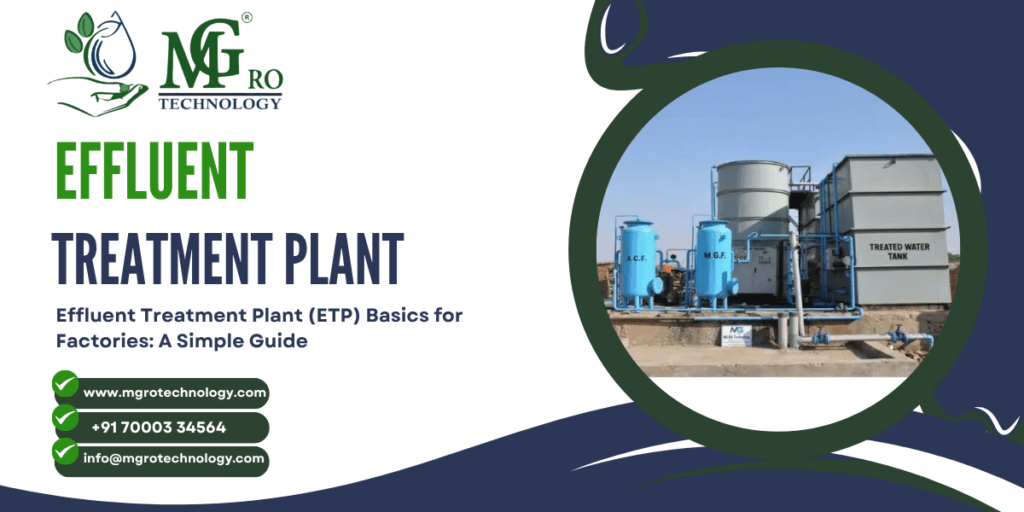
An Effluent Treatment Plant (ETP) is a dedicated purification system designed to treat complex chemical wastewater so it can be safely discharged or recycled inside the factory.
Here is a clear, simple guide to understanding how an ETP works and why your factory needs one.
1. The 4 Basic Stages of ETP Water Treatment
A standard factory ETP processes dirty chemical wastewater through four simple sequential steps:
Stage A: Screening and Equalization (Pre-Treatment)
Screening: Wire meshes trap large floating trash, plastic rags, and metal scraps before water enters the pumps.
Equalization Tank: Factory effluent varies in color, temperature, and chemical strength throughout the day. The equalization tank continuously mixes incoming wastewater to maintain a uniform flow rate and neutral chemical balance.
Stage B: Primary Treatment (Chemical Coagulation)
Dosing chemicals (coagulants like alum or polyelectrolytes) are added to make tiny chemical particles stick together, forming larger clumps called “flocs.”
These heavy flocs settle at the bottom of a primary clarifier tank, removing up to 60% of suspended solids and oil.
Stage C: Secondary Treatment (Biological Digestion)
Wastewater passes into an aeration tank where air blowers continuously pump oxygen into the water.
Friendly bacteria consume dissolved organic pollutants, drastically lowering COD (Chemical Oxygen Demand) and BOD (Biochemical Oxygen Demand) levels.
Stage D: Tertiary Treatment (Final Polishing & Reuse)
The clear water passes through specialized Sand Filters and Activated Carbon Filters to remove residual color, odor, and fine particles.
The treated water meets standard pollution control discharge limits.
2. What Is Zero Liquid Discharge (ZLD)?
For factories operating in dry zones or strict environmental control areas, simple water discharge is not permitted.
In a Zero Liquid Discharge (ZLD) setup:
Treated water from the ETP tertiary filter is fed into an Industrial RO Plant.
High-grade Industrial RO Membranes recover up to 70–80% clean water, which is reused directly in factory production.
The remaining concentrated wastewater is sent to evaporators, leaving zero liquid discharge behind.
3. Key Benefits of Installing an Efficient ETP
100% Pollution Control Compliance: Avoids legal notices, fines, or operational shutdown threats from environmental authorities.
Water Cost Savings: Recycled treated water reduces the need to purchase fresh borewell or tanker water for cooling towers and washing.
Protects Downstream Systems: Pre-treating hard or chemical-heavy water prevents scale build-up inside factory boilers and pre-treatment equipment like a Water Softener Plant.
Summary Table: Common Industrial Effluents & ETP Solutions
| Industry Type | Main Wastewater Contaminants | Key ETP Treatment Needed |
| Textile & Dyeing | High color, toxic dyes, & alkaline chemicals | Color Removal Coagulation + Carbon Filters |
| Food Processing | High organic waste, fats, oils, & grease | Oil & Grease Trap + Biological Aeration |
| Electroplating & Metal | Heavy metals (zinc, chrome) & low pH | Chemical Neutralization + Metal Precipitation |
| Chemical & Pharma | High COD/BOD & complex solvents | Advanced Oxidation + ETP with RO Integration |
Bottom Line for Factory Owners
An Effluent Treatment Plant is not just a regulatory obligation—it is a sustainable investment that lowers fresh water consumption and ensures uninterrupted factory operations.
Looking for customized wastewater management or water recycling setups? Explore our industrial water treatment solutions engineered for high performance and long operational life.