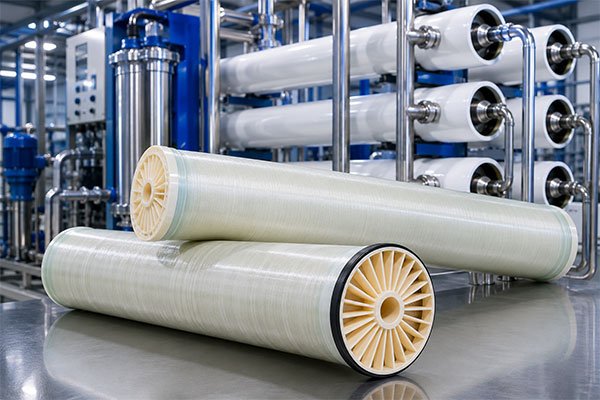
Water quality directly impacts production efficiency, equipment life, and product quality across industries. While pumps, pressure vessels, and control systems are important components of an RO plant, the Industrial RO Membrane performs the actual purification process.
An Industrial RO Membrane is a semi-permeable membrane that separates dissolved salts, minerals, bacteria, organic contaminants, and other impurities from water under high pressure. Modern industrial RO plants commonly use Thin Film Composite (TFC) membranes capable of removing up to 95-99% of dissolved solids, making them suitable for demanding industrial applications.
If the membrane performs efficiently, the entire RO system performs efficiently. If it becomes fouled or damaged, water quality declines and operating costs rise. Industrial equipment has an uncanny talent for reminding you that neglect is always more expensive than maintenance.
What is an Industrial RO Membrane?
An Industrial RO Membrane is a high-performance filtration element installed inside a pressure vessel within a Reverse Osmosis system.
Its microscopic pores allow water molecules to pass while rejecting:
- Dissolved salts (TDS)
- Heavy metals
- Bacteria
- Viruses
- Organic compounds
- Suspended impurities
- Fluoride
- Nitrates
- Sulphates
This produces high-purity water suitable for industrial processing and manufacturing.
How Does an Industrial RO Membrane Work?
The working principle is based on Reverse Osmosis.
Step 1: Pre-Treatment
Raw water first passes through:
- Sand Filter
- Activated Carbon Filter
- Water Softener
- Micron Cartridge Filter
These stages protect the membrane from suspended solids, chlorine, and hardness.
Step 2: High Pressure Pump
A multistage high-pressure pump forces water toward the membrane at pressures higher than the natural osmotic pressure.
Step 3: Membrane Filtration
The membrane allows only purified water molecules to pass through while rejecting dissolved contaminants.
Step 4: Water Separation
The process creates two streams:
- Permeate: Purified water
- Reject (Concentrate): Water carrying dissolved impurities
The purified water is collected for industrial use, while the reject stream is discharged or treated further.
Major Components of an Industrial RO Membrane System
An Industrial RO Membrane operates together with several supporting components:
- High Pressure Pump
- Pressure Vessel
- FRP or SS Membrane Housing
- Cartridge Filter
- Pressure Gauges
- Flow Meters
- Conductivity Meter
- PLC Control Panel
- CIP System
- Dosing Pumps
Together, these components ensure stable performance and consistent water quality.
Types of Industrial RO Membranes
Different water sources require different membrane technologies.
Thin Film Composite (TFC) Membrane
The most widely used membrane for industrial applications.
Benefits include:
- High salt rejection
- Excellent water recovery
- Long service life
- High productivity
Many industrial RO plants use TFC membranes because of their high purification efficiency.
Brackish Water RO Membrane (BWRO)
Seawater RO Membrane (SWRO)
Used where feed water contains extremely high salinity.
Applications include:
- Desalination plants
- Coastal industries
- Marine applications
These membranes are designed for higher operating pressures and greater salt rejection.
Benefits of Industrial RO Membranes
Excellent TDS Removal
Industrial membranes remove a very high percentage of dissolved salts, producing purified water suitable for industrial processes.
Consistent Water Quality
Stable filtration performance ensures reliable water quality for continuous production.
Lower Operating Costs
Efficient membranes reduce energy consumption and minimize downstream treatment requirements.
Extended Equipment Life
High-quality purified water reduces scaling and corrosion in boilers, cooling towers, and process equipment.
Environmentally Friendly
RO membranes reduce dependence on chemical water treatment and help conserve water through optimized recovery systems.
Why Choose MG RO Technology?
MG RO Technology designs and supplies industrial water treatment solutions, including Industrial RO Plants ranging from 25 LPH to 100000 LPH. Their systems use advanced membrane filtration technology to achieve high purification efficiency and are available in customized capacities for industries such as pharmaceuticals, food processing, chemicals, textiles, and manufacturing.
Key advantages include:
- Customized industrial RO solutions
- High-quality membrane technology
- Compact to high-capacity systems
- Energy-efficient operation
- Technical support and installation
- Low-maintenance designs
- Reliable industrial performance
Conclusion
An Industrial RO Membrane is the core component responsible for producing high-quality purified water in every reverse osmosis plant. Selecting the right membrane, maintaining proper pre-treatment, and following regular cleaning schedules can significantly improve system performance, reduce operating costs, and extend equipment life.
Whether your industry requires purified water for manufacturing, pharmaceuticals, food processing, or chemical production, investing in a quality Industrial RO Membrane ensures reliable and efficient water treatment for years to come.