How to Choose the Right Industrial RO Plant for a Chemical Factory
Water is the lifeblood of the chemical manufacturing sector. Whether used as a raw material in formulation, a solvent in processing, or for boiler feed and cooling towers, the quality of water directly impacts your end product’s purity and your machinery’s lifespan. Because chemical manufacturing involves aggressive processes and complex raw feed water, a standard water purifier will not suffice. Selecting the right Industrial Reverse Osmosis (RO) Plant requires an understanding of specific technical parameters to prevent membrane fouling, minimize downtime, and ensure regulatory compliance. This comprehensive guide outlines the key engineering considerations for choosing the perfect industrial RO system for a chemical factory.
Water is the lifeblood of the chemical manufacturing sector. Whether used as a raw material in formulation, a solvent in processing, or for boiler feed and cooling towers, the quality of water directly impacts your end product’s purity and your machinery’s lifespan.Because chemical manufacturing involves aggressive processes and complex raw feed water, a standard water purifier will not suffice. Selecting the right Industrial Reverse Osmosis (RO) Plant requires an understanding of specific technical parameters to prevent membrane fouling, minimize downtime, and ensure regulatory compliance.This comprehensive guide outlines the key engineering considerations for choosing the perfect industrial RO system for a chemical factory.
Key Factors to Consider When Choosing an Industrial RO Plant for a Chemical Factory
1. Conduct a Comprehensive Feed Water Analysis
An efficient industrial RO plant for a chemical factory must be designed according to the actual quality of the source water. Chemical industries may use borewell water, municipal water, surface water, or recycled industrial streams, and each source can have different contaminants.
Before selecting an RO plant, obtain a laboratory water analysis covering important parameters such as:
- TDS (Total Dissolved Solids): Helps determine membrane selection, operating pressure, and high-pressure pump requirements.
- SDI & Turbidity: Indicates the level of suspended particles that can cause membrane fouling.
- Hardness: Calcium and magnesium can form scale on RO membranes if not properly controlled.
- Silica and Iron: These contaminants can contribute to scaling and fouling.
- Organic Contaminants: Certain organic compounds can cause membrane fouling and may require additional pretreatment.
A detailed feed-water analysis gives the manufacturer the information required to design the appropriate RO plant capacity and pretreatment system.
2. Evaluate Your Specific Water Purity Requirements
Different processes in a chemical factory may require different levels of treated-water quality. Therefore, the RO system should be designed according to the actual application rather than using the same water quality standard throughout the facility.
Common applications include:
- Process & Formulation Water: May require low conductivity and high salt rejection to maintain process consistency.
- Boiler Feed Water: Requires effective removal of hardness, dissolved salts, and other scale-forming contaminants.
- Cooling Tower Makeup Water: May have different TDS and water-quality requirements compared with process water.
Clearly identifying where the treated water will be used helps optimize both the RO plant design and operating cost.
3. Calculate System Capacity and Flow Requirements
Industrial RO plants are commonly specified according to their permeate production capacity, such as LPH (Litres Per Hour) or KLD (Kilo Litres Per Day).
The required capacity can be estimated using:
Required Hourly Capacity (LPH) = Total Daily Water Requirement (Litres) ÷ Actual RO Operating Hours per Day
For example, if a factory requires 100,000 litres of RO water per day and the system operates for 10 hours:
100,000 ÷ 10 = 10,000 LPH
It is also important to consider peak demand, storage capacity, production schedules, and future expansion when selecting the RO plant capacity. A suitable design margin can help accommodate fluctuations in water demand.
4. Prioritize Advanced Pretreatment
RO membranes require properly treated feed water. In a chemical manufacturing environment, inadequate pretreatment can lead to fouling, scaling, pressure loss, and reduced membrane performance.
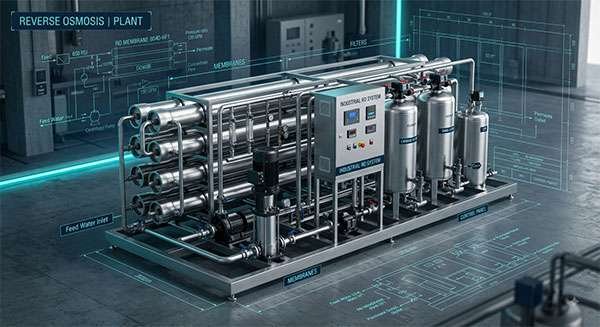
Depending on the water analysis, an industrial RO plant may include:
- Multi-Media Filter (MMF): Removes suspended solids, sand, and particulate matter.
- Activated Carbon Filter (ACF): Helps remove chlorine and certain organic contaminants.
- Water Softener: Reduces hardness and helps control scale-forming minerals.
- Antiscalant Dosing System: Helps minimize precipitation of sparingly soluble salts.
- Micron Cartridge Filter: Provides final particulate filtration before the RO membranes.
The exact pretreatment configuration should always be selected according to the feed-water analysis.
5. Select Suitable Membranes and Construction Materials
Material selection is particularly important when an RO plant is installed in a chemical manufacturing environment.
Polyamide Thin-Film Composite (TFC) membranes are widely used in industrial RO systems because of their high salt-rejection capability. However, membrane selection should consider feed-water chemistry, temperature, pressure, fouling potential, and required permeate quality.
The plant’s piping and structural components should also be selected according to operating conditions. Depending on the application, manufacturers may use:
- SS304
- SS316
- UPVC
- CPVC
- FRP
- Other application-specific materials
For corrosive chemical environments, SS316 and suitable corrosion-resistant materials may be preferred for specific components.
6. Balance RO Recovery with Operating and Wastewater Costs
RO recovery represents the percentage of feed water converted into permeate water.
Recovery Rate (%) = (Purified Water Output ÷ Total Feed Water Input) × 100
Higher recovery can reduce reject-water volume, but excessive recovery can increase the concentration of dissolved minerals in the reject stream and increase the risk of membrane scaling.
Therefore, the optimum recovery rate should be determined according to:
- Feed-water TDS
- Hardness
- Silica concentration
- Temperature
- Membrane configuration
- Antiscalant program
- Required permeate quality
- Reject-water disposal or treatment method
A properly engineered system balances water recovery, membrane life, energy consumption, maintenance, and wastewater management.
Conclusion
Choosing an Industrial RO Plant for a Chemical Factory requires more than selecting a particular LPH capacity. Feed-water quality, required water purity, pretreatment, membrane selection, construction materials, recovery rate, and future production requirements should all be evaluated before finalizing the system.
A properly designed industrial RO water treatment plant can provide consistent treated water, protect downstream equipment, reduce operational problems, and support reliable chemical manufacturing processes.
For chemical industries, working with an experienced industrial RO plant manufacturer is essential to develop a system based on actual water chemistry and process requirements.