Water Softener Plant: Everything You Need to Know
Water is one of the most important resources used in industries, commercial establishments, hotels, hospitals, residential complexes, and manufacturing units. However, not all water is suitable for direct use. Hard water containing excessive calcium and magnesium minerals can create serious operational issues, including scale formation, reduced equipment efficiency, increased maintenance costs, and shorter equipment life.
A Water Softener Plant is specifically designed to remove hardness-causing minerals from water and provide soft water suitable for various industrial and commercial applications. At MGR Technology, we provide efficient water softening solutions designed to improve equipment performance, reduce maintenance expenses, and ensure reliable water quality for diverse applications.
What is a Water Softener Plant?
A Water Softener Plant is a water treatment system that removes dissolved calcium and magnesium ions responsible for water hardness. The system uses ion-exchange resin technology, replacing hardness minerals with sodium ions to produce soft water.
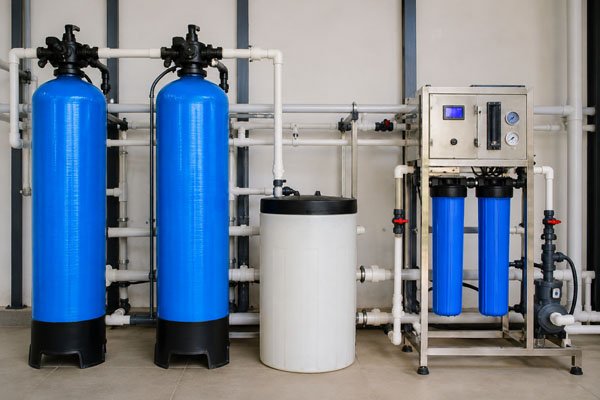
A typical water softening system consists of a mineral tank containing resin beads and a brine tank used for regeneration. As hard water passes through the resin bed, calcium and magnesium ions are exchanged with sodium ions, resulting in softened water.
Why is Water Softening Important?
Hard water can create multiple operational challenges across industries and commercial facilities, including:
- Scale buildup inside pipelines
- Reduced boiler efficiency
- Increased energy consumption
- Frequent maintenance requirements
- Damage to water heaters and process equipment
- Poor cleaning performance
- Reduced lifespan of industrial machinery
Installing a Water Softener Plant helps eliminate these issues while improving overall operational efficiency.
How Does a Water Softener Plant Work?
The water softening process generally follows these steps:
- Hard Water Entry
Raw water enters the softener vessel containing ion-exchange resin.
- Ion Exchange Process
The resin attracts calcium and magnesium ions and replaces them with sodium ions.
- Soft Water Supply
The treated soft water exits the system and is supplied to the application point.
- Regeneration Cycle
After saturation, the resin is regenerated using a concentrated salt solution from the brine tank, restoring its softening capacity.
This continuous cycle ensures consistent soft water availability.
Major Components of a Water Softener Plant
Resin Tank
Contains high-quality ion-exchange resin responsible for hardness removal.
Brine Tank
Stores salt solution used for resin regeneration.
Control Valve
Manages service, backwash, regeneration, and rinse cycles.
Distribution System
Ensures proper water flow throughout the plant.
Pressure Vessel
Provides a durable housing structure for the treatment process.
Benefits of Installing a Water Softener Plant
Extended Equipment Life – Soft water prevents scale formation, reducing wear and tear on equipment.
Improved Energy Efficiency – Scale-free heat transfer surfaces improve thermal efficiency and lower energy consumption.
Reduced Maintenance Costs – Less scaling means fewer breakdowns and maintenance requirements.
Better Process Performance – Industrial operations receive consistent water quality for improved production results.
Lower Chemical Consumption – Soft water enhances the effectiveness of detergents and cleaning chemicals.
Increased System Reliability – Continuous soft water supply helps maintain smooth plant operations.
Applications of Water Softener Plants – Water softening systems are widely used across numerous industries and facilities, including:
Industrial Manufacturing Units – Used for process water and equipment protection.
Boilers and Steam Systems – Prevents scale buildup and improves heat transfer efficiency.
Cooling Towers – Reduces scaling and enhances cooling performance.
Hotels and Resorts – Improves water quality for guest facilities and laundry operations.
Hospitals – Ensures reliable soft water for various utility requirements.
Food & Beverage Industry – Supports water treatment processes and equipment protection.
Pharmaceutical Industry – Used as a pre-treatment stage before advanced purification systems.
Commercial Buildings – Provides better water quality for daily operations.
Water Softener Plant vs RO Plant
| Feature | Water Softener Plant | RO Plant |
| Purpose | Removes hardness | Removes dissolved salts and contaminants |
| Technology | Ion Exchange | Reverse Osmosis |
| Water Recovery | High | Moderate |
| Maintenance | Lower | Higher |
| Operating Cost | Lower | Higher |
| Primary Use | Hardness removal | Complete water purification |
Factors to Consider Before Choosing a Water Softener Plant
Water Hardness Level
Conduct water analysis to determine hardness concentration.
Daily Water Consumption
Select a system capacity that matches operational requirements.
Flow Rate Requirement
Ensure adequate output to meet demand.
Regeneration Method
Choose between manual, semi-automatic, or fully automatic systems.
Space Availability
Consider installation area and maintenance accessibility.
Future Expansion
Plan for increasing water demand and plant growth.
Maintenance Tips for Long-Term Performance
To maximize the lifespan and efficiency of your water softening system:
- Regularly check salt levels in the brine tank
- Monitor water hardness periodically
- Clean control valves as recommended
- Inspect resin condition annually
- Perform scheduled regeneration cycles
- Replace worn components promptly
Routine maintenance ensures reliable and efficient operation for years.
Why Choose MGR Technology?
MGR Technology offers comprehensive water treatment solutions for industrial and commercial customers. The company provides quality-focused water treatment systems, efficient project execution, timely delivery, and strong after-sales support. Their product portfolio includes Water Softening Plants, Industrial RO Plants, Water Treatment Plants, Effluent Treatment Plants, Sewage Treatment Plants, and related solutions.
Conclusion
A Water Softener Plant is a cost-effective solution for eliminating hardness-related problems and improving the efficiency of industrial and commercial operations. By preventing scale formation, reducing maintenance costs, and extending equipment life, water softening systems deliver long-term operational and financial benefits.
Whether you operate a manufacturing facility, hotel, hospital, commercial building, or process industry, investing in the right water softening system can significantly improve performance while protecting valuable equipment. MGR Technology offers reliable and customized water treatment solutions designed to meet diverse water quality requirements.